
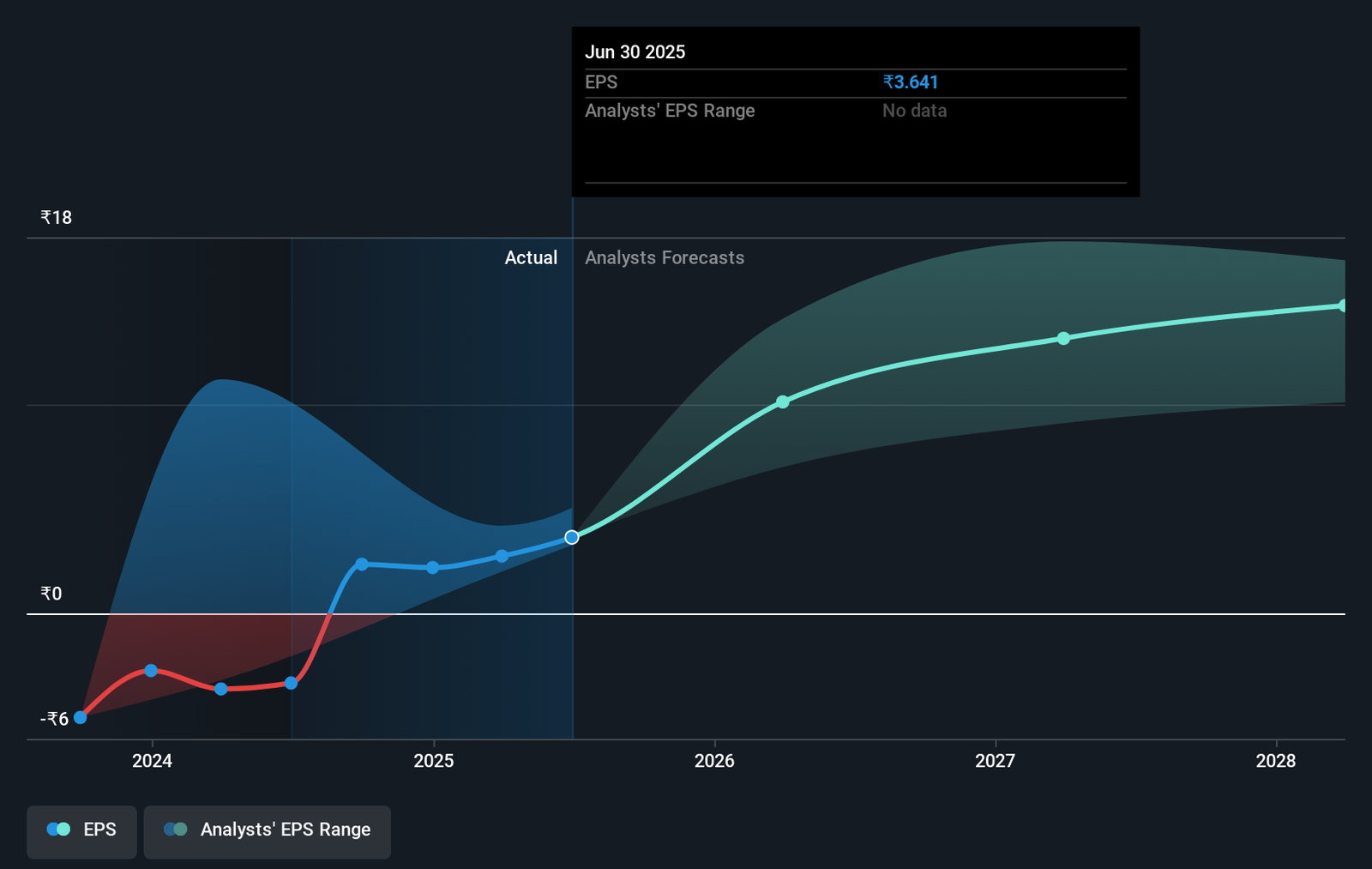
When you buy a stock there is always a possibility that it could drop 100%. But on the bright side, you can make far more than 100% on a really good stock. For example, the Tata Steel Limited (NSE:TATASTEEL) share price has soared 278% in the last half decade. Most would be very happy with that. On top of that, the share price is up 12% in about a quarter.
While the stock has fallen 3.2% this week, it’s worth focusing on the longer term and seeing if the stocks historical returns have been driven by the underlying fundamentals.
To quote Buffett, ‘Ships will sail around the world but the Flat Earth Society will flourish. There will continue to be wide discrepancies between price and value in the marketplace…’ By comparing earnings per share (EPS) and share price changes over time, we can get a feel for how investor attitudes to a company have morphed over time.
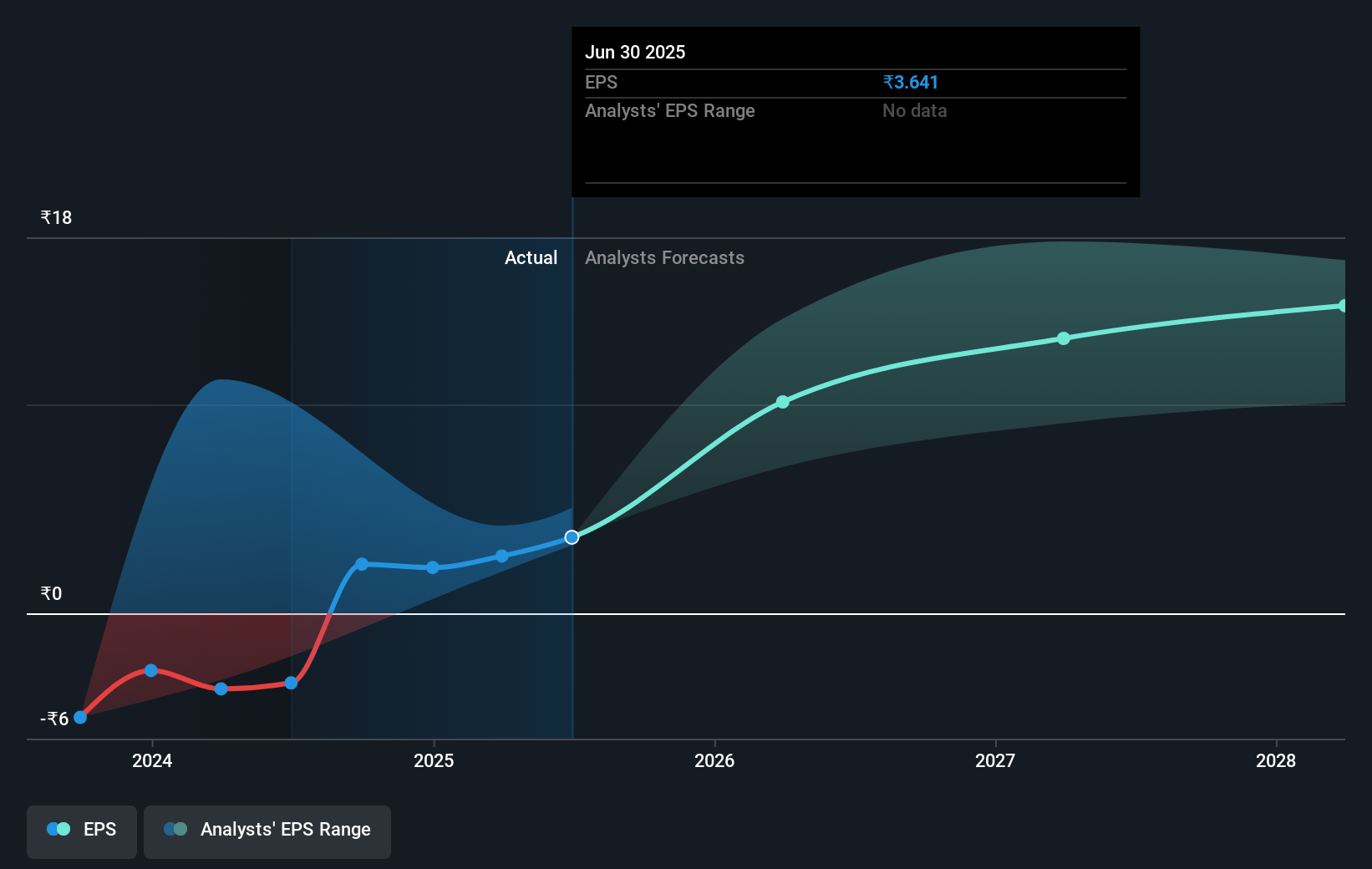
During the five years of share price growth, Tata Steel moved from a loss to profitability. Sometimes, the start of profitability is a major inflection point that can signal fast earnings growth to come, which in turn justifies very strong share price gains.
You can see how EPS has changed over time in the image below (click on the chart to see the exact values).
We know that Tata Steel has improved its bottom line lately, but is it going to grow revenue? If you’re interested, you could check this free report showing consensus revenue forecasts.
What About Dividends?
It is important to consider the total shareholder return, as well as the share price return, for any given stock. The TSR is a return calculation that accounts for the value of cash dividends (assuming that any dividend received was reinvested) and the calculated value of any discounted capital raisings and spin-offs. So for companies that pay a generous dividend, the TSR is often a lot higher than the share price return. In the case of Tata Steel, it has a TSR of 339% for the last 5 years. That exceeds its share price return that we previously mentioned. And there’s no prize for guessing that the dividend payments largely explain the divergence!
A Different Perspective
It’s nice to see that Tata Steel shareholders have received a total shareholder return of 19% over the last year. That’s including the dividend. However, the TSR over five years, coming in at 34% per year, is even more impressive. Potential buyers might understandably feel they’ve missed the opportunity, but it’s always possible business is still firing on all cylinders. It’s always interesting to track share price performance over the longer term. But to understand Tata Steel better, we need to consider many other factors. For instance, we’ve identified 2 warning signs for Tata Steel (1 shouldn’t be ignored) that you should be aware of.
Of course, you might find a fantastic investment by looking elsewhere. So take a peek at this free list of companies we expect will grow earnings.
Please note, the market returns quoted in this article reflect the market weighted average returns of stocks that currently trade on Indian exchanges.
Valuation is complex, but we’re here to simplify it.
Discover if Tata Steel might be undervalued or overvalued with our detailed analysis, featuring fair value estimates, potential risks, dividends, insider trades, and its financial condition.
Have feedback on this article? Concerned about the content? Get in touch with us directly. Alternatively, email editorial-team (at) simplywallst.com.
This article by Simply Wall St is general in nature. We provide commentary based on historical data and analyst forecasts only using an unbiased methodology and our articles are not intended to be financial advice. It does not constitute a recommendation to buy or sell any stock, and does not take account of your objectives, or your financial situation. We aim to bring you long-term focused analysis driven by fundamental data. Note that our analysis may not factor in the latest price-sensitive company announcements or qualitative material. Simply Wall St has no position in any stocks mentioned.