
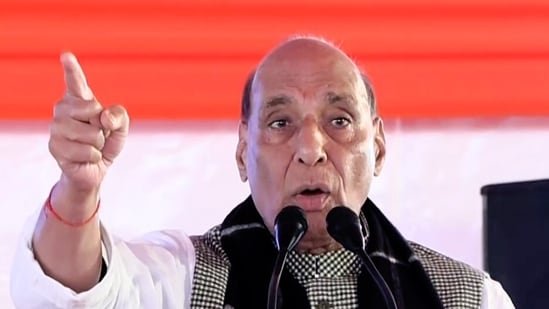
Defence minister Rajnath Singh on Sunday asserted that while Sindh may not be a part of the country, but civilisationally, it will always be a part of India.

He also emphasised that borders often change, and who knows if Sindh may return to India again tomorrow. The defence minister made the remarks while addressing the Sindhi Samaj Sammelan Program in the national capital.
“…Today, the land of Sindh may not be a part of India, but civilisationally, Sindh will always be a part of India. And as far as land is concerned, borders can change. Who knows, tomorrow Sindh may return to India again…” Singh was quoted as saying by ANI.
Also Read | French Navy slams Pakistan media report over Op Sindoor claims: ‘Extensive misinformation’
Further mentioning veteran Bharatiya Janata Party (BJP) leader Lal Krishna Advani, Rajnath Singh said: “He wrote in one of his books that Sindhi Hindus, especially those of his generation, still haven’t accepted the separation of Sindh from India. Not just in Sindh, but throughout India, Hindus considered the Indus River sacred. Many Muslims in Sindh also believed that the water of the Indus was no less sacred than the Aab-e-Zamzam of Mecca.”
Singh also spoke about the Citizenship Amendment Act (CAA), highlighting its necessity in protecting minority communities in neighbouring countries that face violence.
Singh said that the Hindu community in need was overlooked, and Prime Minister Narendra Modi recognised their suffering. He mentioned that this was the reason behind the introduction of the Citizenship Amendment Act (CAA).
Also Read | ‘…if they do it’: Rajnath Singh on India’s response if Pak conducts nuclear tests
“…Minority communities in many neighbouring countries have been suffering for years. Their homes were burned, their children were killed, their daughters were subjected to cruelty and torture, and people were forcibly converted. When many of them somehow managed to escape and come to India, the treatment meted out to them by appeasement-seeking governments cannot be condemned enough. They were humiliated simply to appease the vote bank of a particular community,” he added, according to ANI.
The Sindh region, recognised as the homeland of the Sindhi people, has historically been an important part of Indian civilisation and was also the heart of the Indus Valley Civilisation. The region became part of Pakistan with the partition in 1947.