


When he isn’t writing for our sister site Wargamer or painting Warhammer, Tim is stuck trying to complete Blue Prince.

Published:
“One of the things that we wanted to try and convey for the Necrons was this kind of relentless forward advance,” says Elliot Verbiest, Senior Game Designer on Dawn of War 4. I’m interviewing him about the game’s fourth main faction, undead androids who’ve spent millions of years in suspended animation and are quite grumpy that humanity has woken them up. “It’s something we wanted to represent not only in their unit design, but also with how they acquire their resources” – a system called Dominion that’s heavily inspired by Creep from Starcraft and undead Blight in Warcraft 3.
The Necrons completely ignore one of Dawn of War 4’s key resources, requisition, which everyone else has to secure by capturing control points. Instead, the Necrons have an area of Dominion that – much like Blight or Creep – “spreads out from their structures, and the more of that area that they can cover and protect for themselves, the stronger their economy becomes.” As the Necrons’ dominance spreads, their black-green crystal paves over the map.

Verbiest only revealed the economic dimension of Dominion, and didn’t say anything about it providing the speed boosts of Creep or the health regeneration of Blight. But even as a pure resource system, he thinks it’s going to generate some very interesting gameplay.
“The more you spread your Dominion, the more resources you get, the further you can spread your domain,” Verbiest says, “but it’s very easy to quickly expand your Dominion and leave your base vulnerable to enemies just rushing in.” While almost every Necron structure spreads Dominion, fast land grabs will rely on “the Convergence of Dominion, which is relatively cheap and does this very effectively, but it’s not particularly durable – it’s a pylon of sorts that you can place, but they are quite vulnerable to attack.”
The Necrons do have defensive structures, the mighty Gauss Pylon and lighter Sentry Pylons – ignore the Starcraft-esque name, it’s a coincidence that comes with the Warhammer 40k license. “Sentry Pylons are really cool,” Verbiest says; you can “teleport them around the map on a big cooldown and that helps to expand those front lines.”
Dominion is a boon and a curse, then, freeing the Necrons from the dependence on resource nodes other factions face, but creating a wide frontline to defend. And they can’t totally opt out of the combat for those key battlefield areas, either: “an important aspect of that is trying to suffocate and starve your opponents of resources themselves.”
In terms of standard RTS archetypes, the Necrons are meant to be a “slow but very durable and very powerful faction that has difficulty repositioning their forces, especially early on in the game, but as they become more powerful over the course of a match they gain different tools for their toolbox that allow them to cover for their specific weaknesses.” Teleportation technology, like the aforementioned Sentry Pylons or the Translocation Science Stratagem, can compensate for the murderdroids’ leaden feet – provided you get to the late game.
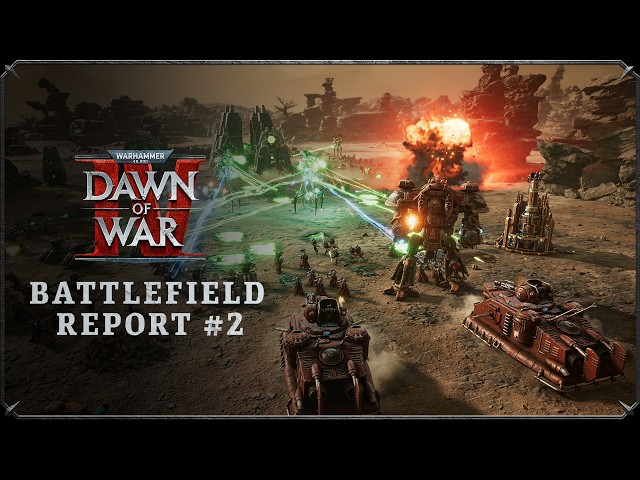
The Convergence of Dominion isn’t the only area where Necron power hinges on a vulnerable building. The Necrons’ hyper-advanced technology manifests both in continuous, free unit repair and repopulation, but also in the new Resurrection Gallery structure. “You basically select a type of Necron unit, and whenever that unit falls anywhere on the map, then it will automatically be regenerated over time and return to the battlefield free of charge,” Verbiest says. A gameplay video of the Necrons against the Adeptus Mechanicus shows both the relentless pressure this allows the Necrons to project, and how devastating it is for them when a Gallery collapses.
Verbiest’s descriptions of involved base building, a slow-burn game plan, and defensive turrets spur me to ask if the Necrons are bringing back turtling in a big way. He says it’s an aspect, though “the Adeptus Mechanicus have a bit more emphasis on defensive playstyles due to how their structures work.”
“It’s all about knowing your positioning on the map, where your units are going to be, when is the right time to expand, and when is the right time to fortify,” Verbiest says. “Figuring that out, ‘can I set the tempo or do I need to be a bit more reactive to what an enemy is doing’ – I think that is what creates a lot of nuance,” and mastering it is “when people become very, very powerful, very effective Necron players.”