


Lauren spends most of her time dead in League of Legends, or equally as dead in Valorant. Don’t ask her about Vampire: The Masquerade.

Published:
I’ve just watched Iron Gate’s Gamescom preview of Valheim 1.0, the survival game’s biggest update to date. There’s a bowl of assorted candy on the table; laughter is flowing, the vibes are, to go all Gen Z, immaculate. Amid levity, joking, and myriad virtual moose, I ask Art Director and Creative Lead, Robin ‘Grimmcore’ Eyre, and Producer Andreas ‘Lumaaah’ Tomasson if what I’ve seen is their final vision for Valheim: their Valheim Opus, if you will. “Not at all,” Eyre says, with a shake of the head. “No?” I responded, shocked. “No,” he replies. “We had visions, but we never thought it would turn into this.”
Let’s start at the beginning. Valheim entered early access in 2021, and, five years on, is finally hitting 1.0 in just a few short days. What was once a small indie endeavor has exploded to become one of the biggest survival games ever – one that’s consistently held aloft as a stalwart part of the genre. 1.0, by Iron Gate’s own admission, has been a slow but steady process; with a team of just nine people and no real intention to expand beyond that number, things have taken time. But on Wednesday September 9, Valheim leaves early access. “It is a long time later – almost 84 years later,” Eyre jokes. “It’s bittersweet: it’s the end of an era, but a start of a new age.”

As someone who’s kept up with Valheim since it launched, what I saw at Gamescom looks and feels like a familiar, yet different game. There are snazzy, animated cutscenes now; ones that help tell the game’s story, and are easily Netflix-worthy. They add a new layer of quality and narrative depth; something the team has always wanted to do. Said cinematic additions also include an ending sequence – yes, Valheim does have an end. While I haven’t seen it, just talking about it reflexively raises goosebumps on Eyre’s skin. In many ways, Valheim 1.0 does, to borrow Eyre’s words, feel like “the end of an era.”
The game’s final zone, The Deep North, is equally as reflective of this. A silent, frozen tundra where, to quote Eyre, Vikings “go to die,” there’s still combat (the zone is home to a colossal Gammeltroll, the biggest enemy Iron Gate has ever produced), yet there’s an element of reverence; of coming home from time well spent, and watching the world slowly drift by. There are two dungeons – The Winding Tunnels, which Eyre wanted to call ‘The Hole,’ as well as a colossal castle-style structure – alongside the usual crafting and building opportunities. But, all in all, The Deep North just feels different from anything else we’ve seen in Valheim. It’s restful, like a swansong.
The Deep North contrasts against the more combat-heavy feel of The Ashlands and Mistlands. The slower tempo is very much deliberate, but also feels reflective of the fact that this is 1.0; it is, in canonical sense, the end of your Viking’s journey.

It’s a switch up in style for sure, so I ask how the team’s development strategy has changed over the years – it’s no secret that Valheim launched as one game, and has (for better) become another. “When we released into early access we were selling one million copies a week for six or seven weeks,” Eyre says. “With that influx of players, we got so many bug reports we had to spend the first six or seven months just fixing the game, because if people are buying and playing the game, we wanted the base version to work for them so that they were happy.
“We were five people back then,” Eyre recalls. “Now that we’re nine people, I feel like we have kind of tightened the pipeline and the workflow that we have, with the pillars that we have. We know what we’re doing now, and we know how long things take. I think the community also knows how long things take for us, but the good thing is that they’ve always responded with ‘take your time: when it’s done, it’s done, and it’ll be good.'”

That begs the question: are Eyre and Tomasson happy with Valheim 1.0? While the duo stress that 1.0 doesn’t herald ‘the end’ of Valheim and that Iron Gate will continue to support and expand the game, it does, from my preview, feel like a huge milestone. We joke for a moment about the fact that you can tame moose in the Deep North – an animal that Eyre tells me the Swedish military has tried and failed to wrangle countless times. “We did it, though!”, he laughs, and I can’t help but agree that this is 1.0’s greatest achievement.
The laughter dissolves, however, and things get a little more philosophical.
“I’m happy with what we’ve got,” Tomasson says. “I’m really proud of the team. We wanted to release [1.0] on the five-year anniversary date to be exact, sadly we weren’t able to make it due to some stuff, but I’m happy with what we have. I wish we could add even more to 1.0, but we’re not done. I feel like the things that we didn’t get to add now will most likely, in some way, be added into the game later. But yeah, I’m happy with it: having an ending, closing it with the outro, it feels like you get a good end to it, wrapping up the whole experience.”
Eyre responds with a resounding “I agree,” but admits that he “always wants to put in more than we are capable of putting in, but at some point Producer Sara [Uvalic] has to step in and say ‘Robin, we have to release the game,’ and that is true.” As a longtime console gamer, though, his biggest achievement is finally launching Valheim on PlayStation and Nintendo Switch 2 (the game is also available on Xbox). “It’s a dream for me.”
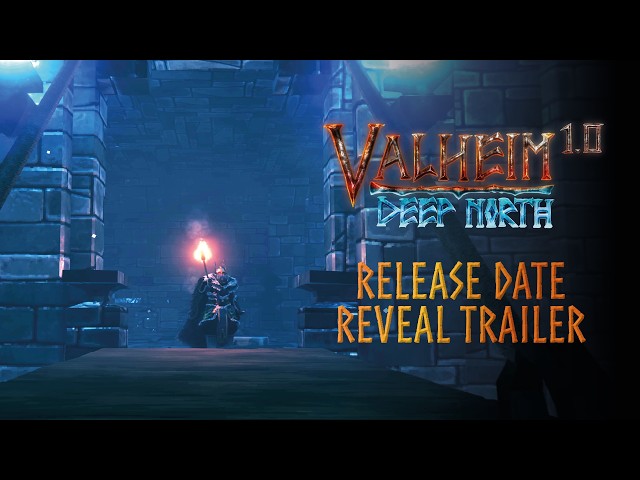
Valheim launches in 1.0 on Wednesday, September 9, after five years of early access.
It’s exciting to see not just the game’s journey, but Iron Gate’s, too. It’d be easy to lose sight of both Valheim’s community and the title’s roots as the money starts flying in – millions of copies isn’t anything to smirk at. But Eyre, Tomasson, and the team at Iron Gate remain committed to their chaotic Viking vision, whatever that may turn out to be. It’s been a pleasure watching Valheim grow over the years; its journey is quite unlike any other, and 1.0 really is a new beginning.
“We always knew Valheim was going to have a set amount of biomes, but we never knew what that was going to look like,” Eyre says. “We did have a vision, we didn’t think it was going to take this long, but we’ve always tried to stay true to what’s good for Valheim first.” I’d argue they’ve done that and more.