
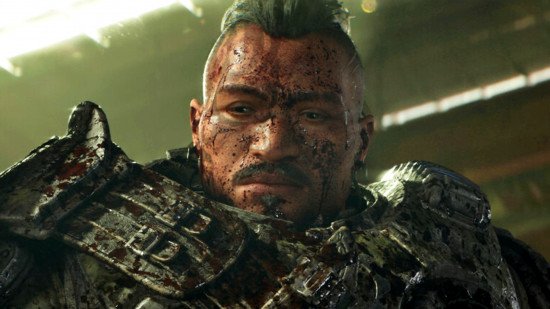
Gears of War E-Day takes us back to the very first days of the Locust War, and in doing so feels very different from where the series has been with its more recent numbered entries. It’s a combined nostalgia hit for long-time fans, and a potential onramp for new players who might be wary of jumping into the likes of a theoretical Gears of War 6. During a pre-launch event in London this past week, I caught up with Creative Director Matt Searcy and Sandbox Designer Pax Lyle to talk about the game’s development, getting the older era to feel right on every control scheme, and what the future might hold.
As a long-time fan of the series, I’m very excited for Gears of War E-Day, and even more so hearing what a great time Tom had with it for our review. I still have somewhat of a bee in my bonnet about the decision to jump back in time before finishing The Coalition’s ‘current-day’ arc, however, especially given how many threads were left hanging at the end of Gears 5, so I had to ask what sparked this decision. Searcy explains that in the wake of that game, the team “made the decision to jump to Unreal 5, which was natural,” but knew that it would be a “huge undertaking” to take full advantage of the new engine.
“Our pitches all had to revolve around looking at what the pillars of Gears are and doing some franchise exploration,” he tells me. “We ran off of Gears 5 into sort of an introspection.” As that continued, the team “started to look at the iconic elements of Gears, the pillars that the old games were built around, and as we were doing that E-Day emerged as the game and the story that we were the most excited to tell.”

Gears 5 carried some very big lore bombs, in particular digging into the history and evolution of the Locust, but returning to the old era meant putting that aside for now. “We’re taking a lot of care not to break the lore,” Searcy notes, remarking that “Marcus and Dom don’t learn those things until partly in Gears of War 2, and Marcus more in Gears 5.” He adds, “If we have to change something we’re being very respectful, like Tai’s chainsaw moment, we sort of lifted it out of a book and placed it in Kalona, but kept it as intact as possible.”
One aspect of the series that has changed most over the years is that it’s now consistently released on PC alongside Xbox (we did get a port of the 2006 original, but that was it for quite some time). The fourth and fifth mainline entries feel fantastic on mouse and keyboard, and what little I got to play of E-Day during the event was every bit as responsive. Lyle says the team worked to ensure that neither keyboard and mouse nor controller felt like “the way to play the game” to the detriment of the other.
“There is quite a bit of work that goes into ‘how fast can you move the camera, what kind of different options can we give you for how you can map the keyboard, and different sorts of modes you can use for how sprint works.'” Lyle notes that if your background is in other shooters that aren’t quite like Gears, you “might need to make some adjustments to the controls” to find what works for you, but he hopes you’ll get there. Fortunately, even the most difficult modes aren’t limited by your chosen settings here, nor the robust suite of accessibility options, so you’ll be able to push your limits however you prefer to play.
Speaking more generally, The Coalition has worked to make the action feel even smoother, although Searcy emphasizes that keeping that “weight and heaviness” is still fundamental to Gears of War. “One of the moments that really resonated for us is sliding into cover – you get dust kicking up, you get denting in cars, you get the sound.” We’ve also had the benefit of two beta tests, and Searcy says that the team has “made some minor adjustments” to movement in the wake of that to “hit that right line of the gameplay experience versus the feeling of the presentation and the weight.”
Returning to an earlier era means more limited tech for our protagonists, and less familiarity with what the Locust and their accompanying cast of creatures can do. That results in more palpable fear and uncertainty. “The first act is just a monster story, you’re not even in armor yet,” Searcy notes, “and every gun you get is the first gun these guys have picked up.” Lyle chimes in, “The Wretch, for example, you start the game basically without weapons to fight back against it. You’re just using melee, so it’s bringing that terror right into your face.”
The timeline naturally means hostile forces are also a little more primitive than the versions we’re already familiar with, too. “The Brumak, the first time you encounter it in E-Day, it actually doesn’t have a full set of weaponry like you see in the later games,” Lyle explains. “It’s just attacking you with these huge chains and sort of ripping through the environment with these giant melee weapons.”

E-Day will put you even more on the back foot than normal. “It’s all built to kind of get you to the point where you’re down to your last bullet, having to decide if you’re going to dump that gun and grab something off the ground,” Lyle remarks. That’ll depend somewhat on your chosen difficulty level as well; “When you get good and you up the difficulty, the combat puzzle gets stronger – it’s less about just whack-a-moling people faster, you actually have to start thinking about your cover, position, your loadout, when you move, when you expose yourself.”
As for what might come beyond the launch of E-Day, it remains an unknown for now, and Searcy has no answers. “Basically the whole team’s been focused on building this game. It is a pretty exciting place to be,” he muses. “E-Day takes place over three days right at the beginning of the Locust War, and there’s a decade of stories potentially to tell in there.” Given the continued uncertainty at Microsoft right now, with E-Day’s Story Director Juan Vaca notably among those hit by the most recent round of layoffs, I can only hope that the studio is afforded the chance to tell them.