


If anyone fancies watching Zak’s Miami Vice Blu-ray collection, hit him up.
Published:
The Warcraft universe is a sprawling storytelling tapestry told across media from different genres. Whether you’re a fan of the classic strategy games, the MMORPG, or even the oft-overlooked movie by Duncan Jones from 2016, you’re invested in the story of Orcs and Pandaren and the decades of lore that have been laid down as the franchise has continued to evolve.
But what about Hearthstone? My initial thought is always to accept everything as canon and let the details sort themselves out later. As a fan of The Terminator and Fox’s X-Men film series, that approach has led to its fair share of headaches, but I digress.
If you’re not familiar, Hearthstone is a deck-building card game that uses the lore of Warcraft as a launchpad to do its own thing. But is it canon? At BlizzCon 2026, I participated in a group Q&A with Executive Producer Nathan Lyons-Smith and Lead Game Designer Brendan Sewell. They were there to talk about the new Journal feature, as well as the 2v2 mode coming to the game soon, but I couldn’t help but ask about the story ramifications of the new Journal.

So I asked, in so many words, ‘Is Hearthstone canon?’ Lyons-Smith explained, “Hearthstone’s strength is that it’s tales told in the tavern around the hearth. And that means they can often be tall tales. You don’t actually know if it really happened, right?” Essentially, he’s saying that Hearthstone stories are about as truthful as any story you can get asking an old barfly at your local divebar. “We’re going to take you on a journey of what maybe your experience would be during the reign of the Black Empire.” Granted, Hearthstone doesn’t have the same storytelling gravitas as other Warcraft media, so it’s more about the general vibe of the experience, rather than conveying a one-to-one representation of ‘true’ events. Given the card-based gameplay and how it draws from all of Warcraft, that’s probably a good decision.
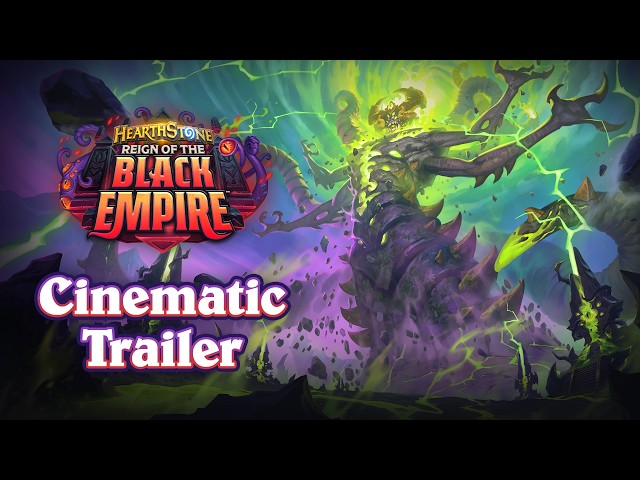
The upcoming ‘Reign of the Black Empire’ expansion (launching Tuesday October 20) includes the aforementioned Journal, a way to tie together all of your Hearthstone adventures into something resembling a narrative. “The original narrative that is going to appear in the first chapter of the Journal is strictly linear,” Sewell explains. “It’s going to unfold as the weeks occur and you are committing to these quests and we’re unfolding the narrative over the course of the expansion.” Think of the Journal as more of a personal scrapbook rather than a ‘History of Warcraft’ textbook.
In acting as a personal scrapbook, the Journal also allows players to catch up if they’re the casual type who don’t play every single day but still want to check in when new content drops. Sewell explained that it’s a way for Hearthstone to remain relevant in players’ minds in a way the game maybe hasn’t always been able to achieve. “Prior to Reign of the Black Empire, there would be cards, but then we didn’t always deliver all the narrative, or sometimes it would be in different, like, web areas, and we’re trying to put all of that in the game and bring everything cohesively together.” The way he explained it, the Journal is both for regular players and newcomers alike: “I think of it as a fun way to experience Hearthstone between those big content drops for our most core players. And for new players wondering, ‘what’s going on?’ it’s some narrative to help them along.”

As for synergy across the Warcraft mythology beyond Hearthstone, that style of loose storytelling means there’s no limit to what types of cards and scenarios can pop up in Hearthstone. Sewell explained, “We have a good working relationship with Team 2 over on the ‘World of Warcraft’ side of things. We’re in pretty regular communication, even in an average expansion, where we’re simply going in and referencing the lore and making sure that we’re being respectful to the world of Azeroth and being consistent there. It also helps that we have a lot of former Hearthstone card designers that have spread out across Blizzard.” In that way, Hearthstone has grown from a wacky little spin-off into a pillar of Blizzard and the Warcraft juggernaut, with its tendrils spreading into other Warcraft stories.
But does that mean we’ll ever get a full-on “Avengers”-style crossover? Like, for instance, an expansion story that begins in Hearthstone and continues across World of Warcraft and World of Warcraft: Forever? It sounds tempting, but ultimately, probably not, and it’s because Lyons-Smith has Hearthstone players in mind. “Maybe half of our players are heavy into the Warcraft IP, and then roughly another half are just here for the cool card game part.” It would be a shame for a Hearthstone story to end with “to be continued… In a game you don’t play!” Sure, a little corporate synergy goes a long way, but you don’t want to push it too hard, or else Hearthstone won’t feel like a complete game on its own, but an addendum to other Warcraft properties.
It’s a tricky line to walk, as Lyons-Smith explains: “I always try to find the right balance between this heavy Warcraft experience versus something that doesn’t have to rely on a bunch of World of Warcraft knowledge. On and off, we will do tighter or looser connections with what the World of Warcraft team is doing. Murder at Castle Nathria is probably the closest we’ve gone (to a full crossover). There is some content cooking, and at some point we’ll be able to talk about that. But we really want to make sure the other teams get their moments to announce their content, and that we’re not before them for their content.”
Overall, Hearthstone is a quiet giant: a successful game that chooses to walk behind World of Warcraft, but not simply exist in its shadow. Okay, maybe that imagery is a bit melodramatic, but it shows that Hearthstone has a prominent place in the Warcraft ecosystem, but it’s not the nexus point of the ever-expanding story of the series. It’s more like a prism through which fans can explore the lore at their own pace while enjoying a jolly card game.
Keep scrolling for next article