
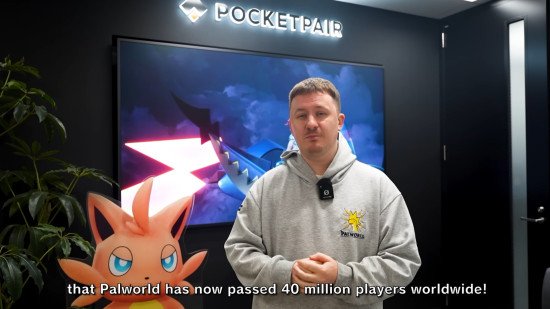
Palworld might have reached a whopping 40 million players this year, but developer Pocketpair still thinks of itself as an indie studio. It’s a term that’s become increasingly difficult to parse in recent years, gradually growing less and less defined. Does a small developer backed by a major publisher, like Expedition 33’s Sandfall Interactive, count? What about a small subsidiary of a bigger company, such as Dave the Diver’s Mintrocket? Or in Pocketpair’s case, a team that has rapidly grown thanks to the sheer success of its companion-collecting survival game?
“Where does the indie line begin and end?” Head of Publishing and Communications John ‘Bucky’ Buckley ponders the question in response to a contemplative piece on the topic from Japanese gaming outlet Damonge. That article bounced off comments made by Pocketpair CEO Takuro Mizobe in an interview with VGC that it’s “a true indie company” and intends to “keep making games in that indie way,” despite admitting that the studio’s size and success could be considered “approaching the double-A level.”
Speaking via X, Buckley writes, “We consider ourselves indie because we have zero outside investment or backing. Palworld and Pocketpair are entirely self-funded, but it’s understandable that our success makes people see us differently.” He points out that “many studios considered ‘indie,’ including some that have won major awards and achieved huge success, have received funding and backing from much larger companies.”

He concludes that while it’s tempting to set a specific employee headcount at which the indie label no longer applies, it’s not a clear enough definition. Instead, he argues that the term should be more about actual independence. “If a studio has genuine creative freedom, then I think it’s fair to consider them independent. If another entity is exerting creative pressure or making decisions for a studio, then I think that independence becomes questionable.”
This naturally includes some of those studios who are receiving external funding, as such assistance doesn’t necessarily come with any loss of creative control. “I don’t think having a publisher or investor automatically makes a studio any less indie,” Buckley asserts.
“I know many people will disagree, and some will point to our size or the amount of money Palworld has made as reasons why we shouldn’t use that label. But from our point of view, we’re 100% self-owned, we have no outside investors to answer to, and we have complete freedom to make the games we want to make. That’s what being indie means to us.”
Defining such genres and markers has always been more about feel, and ‘indie’ is a particularly difficult one to wrangle. Should it be about the studio’s level of control over what it’s making, or does it represent the struggle that a small team with little funding must overcome to find an audience? At this point, Pocketpair has grown its own publishing arm and is working to help other indie games along that journey, including the likes of Windrose, Truckful, and Clicky Islands.
“If you’d rather call us triple-i or double-A, that’s fine too,” Buckley concludes. “Ultimately it’s just a label and all that really matters is we’re still making fun games.”