
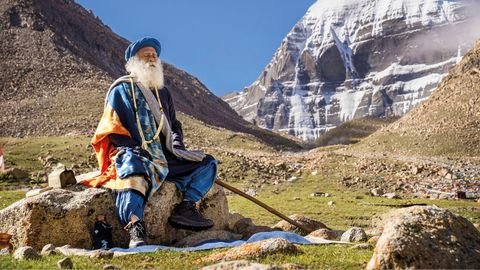

Spiritual leader and tireless traveller, Sadhguru has long believed that the journey is the destination. From sleeping on his motorcycle to discovering profound truths at Mount Kailash, he reflects on a life in motion—one shaped by simplicity, exposure, and the spirit of seeking. He reflects on the joy of constant motion, how travel shaped his path to inner exuberance, and why the road, the ride, and the unknown are his greatest teachers.
Excerpts From The Interview With Sadhguru
T+L India: What are your personal wellness secrets—practices, rituals, or philosophies—that keep you grounded and energised?
Sadhguru: If you are really doing what you care for, then your entire life is a vacation. Even if you work 24 hours a day, it is not burdensome, because you are doing what you love to do. This is why, for me and thousands of people around me, we are on non-stop, seven days of the week, 365 days, simply because we are creating what we really care for. This philosophy has started going around in the world: “Thank God, it’s Friday!” If you do not enjoy what you do five days of the week, why are you doing it? Because life is very brief. And when you do not enjoy what you are doing on a day-to-day basis, how will you enjoy the weekend? We must understand, there is no such thing as enjoying something or suffering something. The question is: “Are you joyful or are you miserable?” If you are joyful by your own nature, everything that you do will be an enhancement of joy; if you are miserable, everything that you do could enhance your misery. Instead of looking for something that you can enjoy, just become joyful, because human experience happens from within.

T+L India: In your view, what does purposeful and conscious travel look like in today’s world?
Sadhguru: People travel for various reasons. Explorers have travelled to conquer or to know; vagabonds—because they could not stand home; and tourists—because they need a break from their work or their family. Travel essentially means you want to face unfamiliar situations. It is about breaking all those things that have been taken for granted—constantly being in known, settled atmospheres, within four walls, and developing a very freaky sense of how everything should be. If your travel takes away the comfort of your home, the order of things that you are used to, the simple and complex pleasures that you have built around yourself, the sense of too much concern that you have about your own wellbeing, and brings a certain amount of dispassion about yourself, it will definitely be of some significance. So, travel should be a little adventurous—not in search of comfort, but in search of exposure and new experiences.
T+L India: Could you share your most profound or transformative experience while travelling?
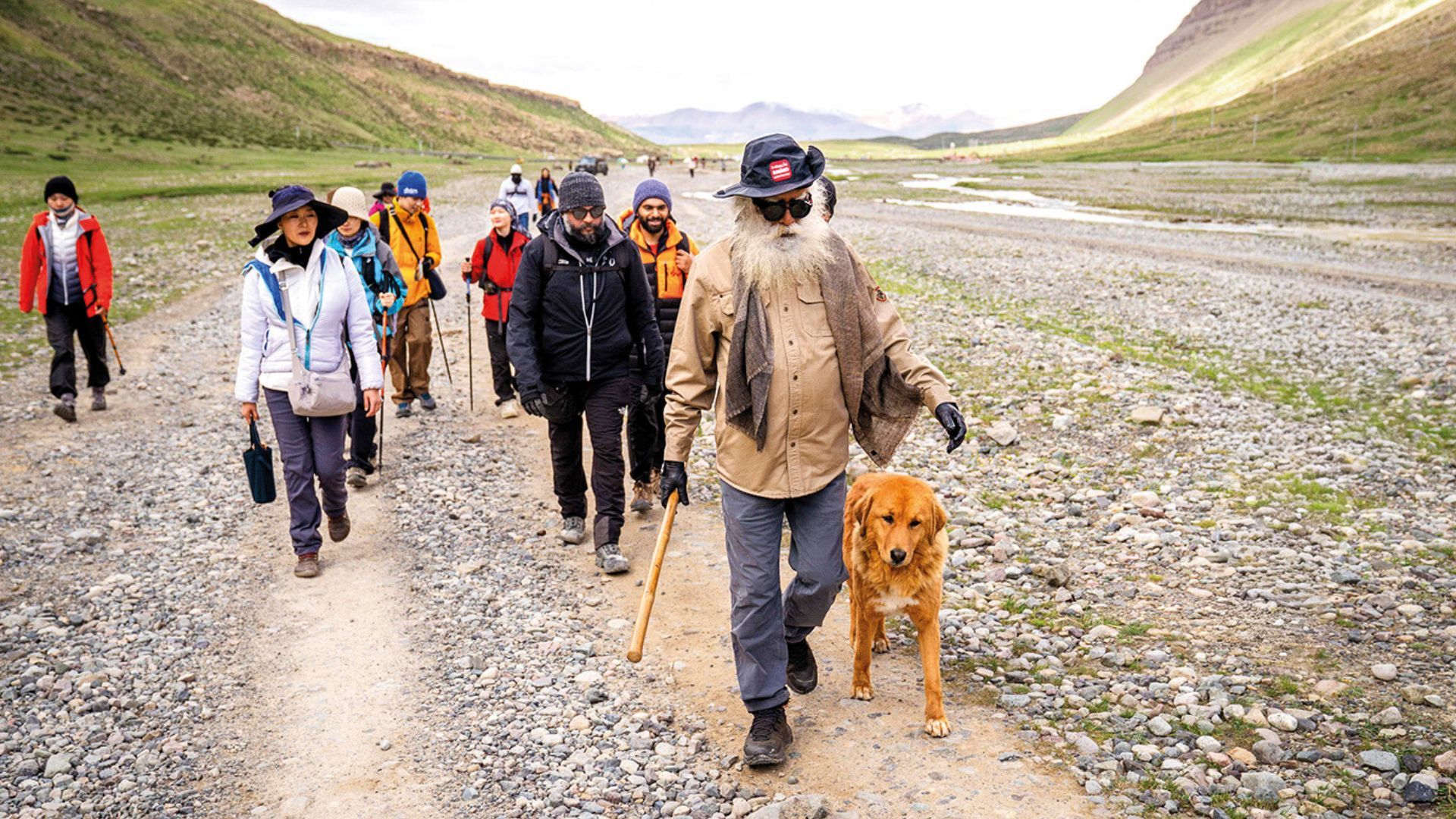
Sadhguru: I am not in an inner state where I need to do any pilgrimage. But still, the pilgrimage to Manasarovar and Kailash has been absolutely astounding for me in terms of experience. I never expected it to be that way, because I have seen enough and been through so much of life that nothing really surprises me. It does not matter what I see, because I have seen the strangest of the strange and the weirdest of the weird in my life. Things that you cannot believe—things which are like fairytales to people— have been a daily reality for me. But Manasarovar and Kailash were well beyond anything that I have seen till now. Mount Kailash is a tremendous spiritual library. In terms of inner dimensions, anything that you ever want to know is in Kailash. If you know how to perceive and decipher it, everything that you ever want to know about your own creation, your existence, and your liberation—it is all there.

T+L India: How has travel informed your work in wellness and impact?
Sadhguru: When I was a little under twenty years of age, for about four years, I literally lived on a motorcycle. In a year, I was doing around seventy thousand kilometres on very bad roads. When I rode, I was not riding to any destination. I just rode—simply from one end of the nation to the other. That was an incredible process for me, because I saw India like very few people have experienced it. I know the people, the food, the way people smell, the way they think, the way they feel—it is very difficult to put into words.
Back then, I would have money only for gas and nothing else. So, I slept on my motorcycle any number of nights. I also had a little tent, which I would sometimes pitch in the forest for the night. But I generally stayed in people’s homes—homes where I did not know who they were. I never asked them what their names were, and generally, they did not ask me what my name was. I just rode into some village, went to someone’s home and said, “I’m hungry.” This is the beautiful thing about this country. Without asking me my name, most of them fed me. Sometimes, I slept in their homes overnight, and the next morning, I left. I think that is the biggest lesson that came with my motorcycling—that I did not have to possess anything to make it mine. I did not have to know people to make them a part of my life. I did not have to own the land to make it mine. I have already made everyone mine. And because of this, my life is constantly exuberant and phenomenally rich.
T+L India: The best meal you’ve ever had on your travels—and the story behind it.
Sadhguru: From the age of nineteen, I trekked in the Himalayas every year for twenty-seven years. In those days, when we came to northern India, we would have the last best meal in Vijayawada. Once we crossed Vijayawada, it was just aloo—aloo puri, aloo mutter, aloo gobi, aloo, aloo, aloo. Except aloo, there was nothing. By the time I came to Haridwar, I would be done with aloo. In that part of the country, there are tiny little apples. I would just buy those on the roadside, put them in my bag, and go on eating apples throughout the day because I could not eat any more aloo. Nowadays, I travel at least three hundred days a year, so I eat what is offered to me. I do not have much choice about what I eat.
Related: Letter From The Editor: On Wellness And Sustainability Beyond The Buzzwords
Note:
The information in this article is accurate as of the date of publication.
The views expressed in this interview are solely those of the interviewee and do not reflect the opinions of the publication.
Written By
