
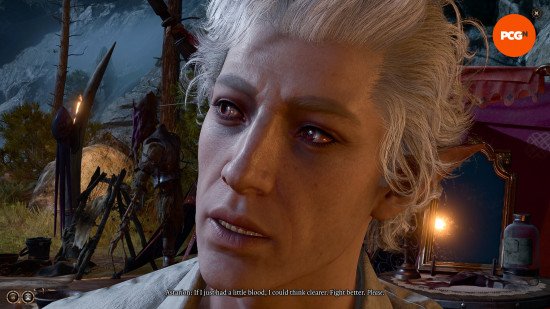
The Blood of Dawnwalker revolves around its semi-vampiric lead Coen, and while he takes a little while to establish some character, I really grew to care about his journey by the end. It leans heavily into the themes of what makes us human, along with the ‘curse’ that eternal life can become – something I hope developer Rebel Wolves explores more in future games. To celebrate its launch, Coen’s actor Will de Renzy-Martin joined forces with another of the most beloved vampires in gaming, Baldur’s Gate 3’s Astarion, Neil Newbon.
“There’s something about the ennui of being given immortality, with restrictions, and with a dependency,” Newbon muses. It’s a framework that both RPGs take great pains to explore in a more nuanced form. For all his suaveness and swagger, Astarion clearly isn’t happy about the fate that’s been thrust upon him, and his most vulnerable moments come when he’s forced to confront that need to feed. “I definitely approached him as a person,” Newbon explains.
“Ultimately, the superobjective of that character was always to be free, because he’s a traumatized captive of this horrible person.” The vampire trope is always there, Newbon remarks, throwing his hands up cartoonishly and hissing. “The task of the actor is to almost ignore that aspect to some degree and say, ‘Who is the person underneath?’ And actually really flesh that out, so then you can add vampirism on top of it, and it’s just part of their natural world.”

The Blood of Dawnwalker takes a more explicit approach to that divide – while traditional Vrakhiri cannot survive in open daylight, Dawnwalkers such as Coen shift between Vrakhir at night and human during the day. “They can’t go out in the daytime, but he can,” de Renzy-Martin says, “and so he’s faced with these choices of how he interacts with the world – who he chooses to feed on, how he chooses to treat people, what kinds of friends he wants to make.”
Friendships are important in The Blood of Dawnwalker, but they’re hard to make. Beyond initial companion Anca, most of your potential allies – and even some of the romance options – are extremely cautious of Coen at first, keeping him firmly at arm’s length. Watching that gradually change in subtle ways as you spend more time with them helps lend weight to the relationships. Yet for Coen, there’s always the lingering issue that his existence is a different one from that of his human associates.
“We can make friends, and if you’re immortal, your friends are going to die at some point,” de Renzy-Martin notes. “It changes what meaningful relationships are when there’s that power dynamic, that life expectancy dynamic, between the two of you.” The result, as Newbon suggests, is that Coen is “neither part of one world nor part of the other, he’s in this kind of ‘no-man’s land’ in between everything.”

Both Larian Studios and Rebel Wolves took the bold approach of being willing to cut off entire questlines and characters in a flash; in The Blood of Dawnwalker, Coen’s thirst can lead to him unexpectedly killing major allies or questgivers if left unchecked. Newbon turns to the crew behind the camera: “Rebel Wolves are insane, what are you people doing?” He laughs. “I love it, it’s great!”
“They’ve made a rod for their back,” de Renzy-Martin responds, “but I think they’ve pulled it off as far as I’m aware.” Having put 60 hours in during my Blood of Dawnwalker review and explored several alternate ways that major questlines can branch, I’d say it works remarkably well. I did manage to avoid any major slip-ups (aside from times I intentionally experimented with what could happen on a backup save), but only because I was so focused on it that keeping Coen’s health topped off was constantly at the forefront of my mind.
“It became a bit of a running joke in the recording sessions,” de Renzy-Martin recalls, “that we’d go through these long, complicated dialogues of branching this, that, the other. ‘If you have spoken to this person and maybe they know this about them, you can ask them this question.’ And then it would get to the final two lines and it’s like, ‘Oh, and this is what happens if you just eat them straight away!'”
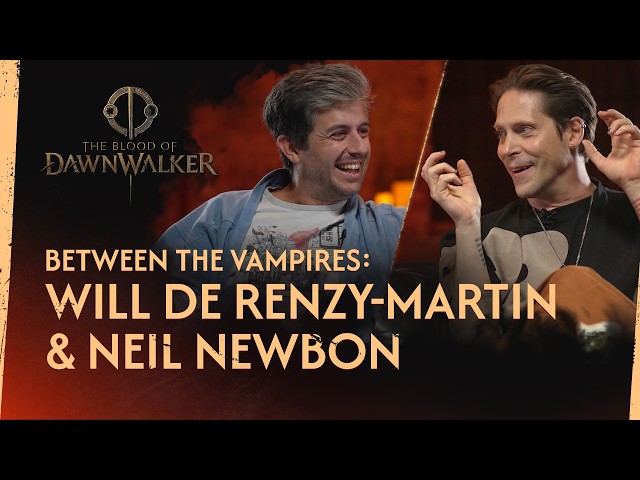
As for his bloodsucking inspirations, de Renzy-Martin reveals that the first vampire who really stuck in his mind was Kain from the Legacy of Kain series. “I think I was about ten or 11 years old when Blood Omen 2 came out,” he recalls, “and I remember seeing the trailer and thinking, ‘That’s the coolest thing I’ve ever seen.'” He mentions that trying to find close comparisons for Coen was tougher, however.
“It goes back to some of the stuff we’ve been talking about: how vampires are these powerful characters, but Coen is a weak character, fundamentally. He’s a vulnerable human that stuff happens to. Maybe the closest you could get is something like Blade,” he ponders, “but Blade is a badass. And, definitely at the beginning of the game, Coen is not a badass.” He hopes players “can associate with that weakness, and wanting to protect the things that we love, but not having the power to do so.”
By the end of The Blood of Dawnwalker, my Coen certainly felt like he had earned that ‘badass’ moniker, and even swarms of Brencis’s finest guards couldn’t really stand in my way. For de Renzy-Martin, the defining moment is one particular turn of phrase. Coen “stands up and he’s in full control of the things he needs to do what he wants, and he’s just got a really badass line that says, ‘You don’t give up easy, do you? Well, neither do I.'”
We’ve already been given a glimpse into Coen’s potential future, with that Game Awards teaser of him in a modern-day apartment. As eager as I am to discover the next chapter of his tale, I’m also looking forward to how that time jump could dig deeper into the curse of longevity, and how Vrakhiri grow numb to the world around them over time. Newbon quotes German philosopher Arthur Schopenhauer: “The shortness of life, so often lamented, might be the best thing about it.”