


Paul’s an expert in Videogames, Star Trek, flannel shirts – in that order.

Published:
Hell Let Loose: Vietnam is a kind of sideways successor to Hell Let Loose; not necessarily better-than, just a different, slightly more chaotic take on the first television war. Gone are the defined frontlines of mainland Europe – instead we get dense jungle, a sometimes invisible enemy, and quite a gulf in technology.
I wanted to know what the thought process was in this transition, and how the team over at Expression Games approached it from a technical and also a moral standpoint – the US involvement in the war was controversial, and its widespread coverage on home soil gave the public a deep, and at that point, unprecedented look into the horrors of the conflict.
I had the pleasure of sitting down with Sam Warren, Kieran D’Archambaud, and Paul ‘Rushy’ Rustchynsky (Development, Studio Technical, and Game Directors, respectively) to go behind the scenes of the development of Hell Let Loose: Vietnam, the issues they encountered during the process, and what the team had to be careful of.

We started, as things tend to do, at the beginning. The shift from World War II to Vietnam, while pop-culture-cool, is quite jarring when you think about it. Both conflicts have soldiers with guns firing at each other, but other than that, there really aren’t many other similarities. The environment itself played just as much a part as any weapon did, and the NVA’s familiarity with that negated a lot of the advanced technology brought by the US forces.
It turns out the reason for the shift was because of the challenge, with Rustchynsky telling me that the Vietnam War represents a “very different kind of battlefield. That, crucially, provides us with a range of gameplay opportunities to allow us to evolve the Hell Let Loose formula … still building around communication and team play, but introducing the asymmetrical elements in a vastly different type of environment.”
Interestingly, the team doesn’t see Hell Let Loose: Vietnam as a successor to the original but as more of a “complementary product” – something that players will dip in and out of depending on their mood. “It’s not a sequel that we want everyone to leave World War Two and jump into Vietnam,” Rustchynsky continues, “Whilst at the core [the two games] are the same, they are genuinely quite different experiences when you’re playing them.”

One of the biggest differences between the two games is just how lopsided technologically the forces are in Hell Let Loose Vietnam compared to the relative parity the World War II sides enjoy. “There was a lot of struggle and back and forth about what it is, the symmetrical elements that we wanted to provide players.” Rustchynsky tells me about how “a lot of the time, you know, things don’t work out how you expect when they first go into the game.”
Attempting to balance these two sides, and making each one just as enjoyable as the other to play, seemed, to me, like an absolute nightmare. “This was by far the biggest design challenge for this game,” D’Archambaud said, talking about how in the early playtests, the helicopters were the dominant strategy, but then going back and reworking the NVA tunnel system made that overpowered. Balancing these asymmetric approaches to travel evolved over the development process, with Rushy commenting that “we didn’t quite expect players to utilize them in this way,” meaning it was back to more tweaking – “it’s this constant back and forth between the two.”
Paying respect to the source material takes the form of staying grounded in realism, and the team let me in on their superpower – a man named Matt. Matt white isn’t only the Creative Director of Hell Let Loose: Vietnam and the co-founder of Expression Games; he’s also, apparently, an extremely hungry historian.

“He absolutely loves it if we ever ask him a question and he doesn’t know the answer because it gives him an excuse to go and buy another book.” Using reference material, Matt was able to advise on the NVA boat you’ll see in the game, for example, which didn’t exist in the form we see it, but was created using real-world components and era-appropriate technologies.
D’Archambaud distils the principles of approaching the source material like this, saying, “There are times when we will make changes. But the core of every single thing, whether it’s location, weapon, or what clothes the characters are wearing. Everything is based on historical fact.”
Getting the correct sources of information is an important thing for Matt, I’m told, making sure not to rely solely on US documents, for example. Bias will inevitably creep in, and while Hell Let Loose isn’t necessarily about telling a story, it could be easy enough to view the entire conflict from one angle.

This is the fine line between depicting what happened and also, you know, making a game. From what I’ve seen and played, I think Hell Let Loose: Vietnam does a better job at balancing realism and enjoyability than many. It doesn’t fall into the Hollywood trap; it’s bombastic, but not egregious.
Paying respect by being accurate is certainly one way to do it, and having played Hell Let Loose: Vietnam, it certainly isn’t glorifying the conflict. Several ‘famous’ aspects of the war aren’t present here, with nearly all of the guerrilla-type methods absent – the Vietcong do not feature here either, with the North Vietnamese Army making up the entirety of the US opposition.
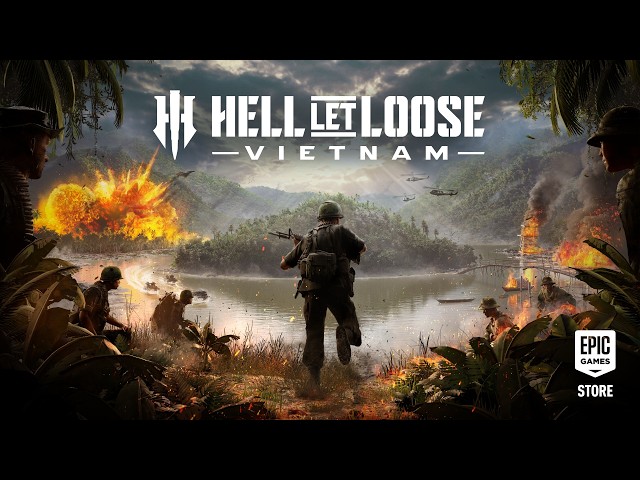
Rustchynsky boiled down that thought process: “That line was drawn very well in development, and not just from the perspective of being sensitive to the subject matter, but also asking the question of, is any of that stuff actually fun for gameplay? And largely the answer was no.” Taking the entire war and distilling it to what is fun might seem like an unenviable task, but what’s on offer here is solid; it feels grounded, and with what limited authority on the subject matter I have, it feels respectful.
Hell Let Loose: Vietnam is out right now, and we have a full review of it here if you want more of our thoughts. HLL is a marriage of historical accuracy and reducing friction; it’s about not taking liberties for the sake of it, and I think it’s all the better for it.