
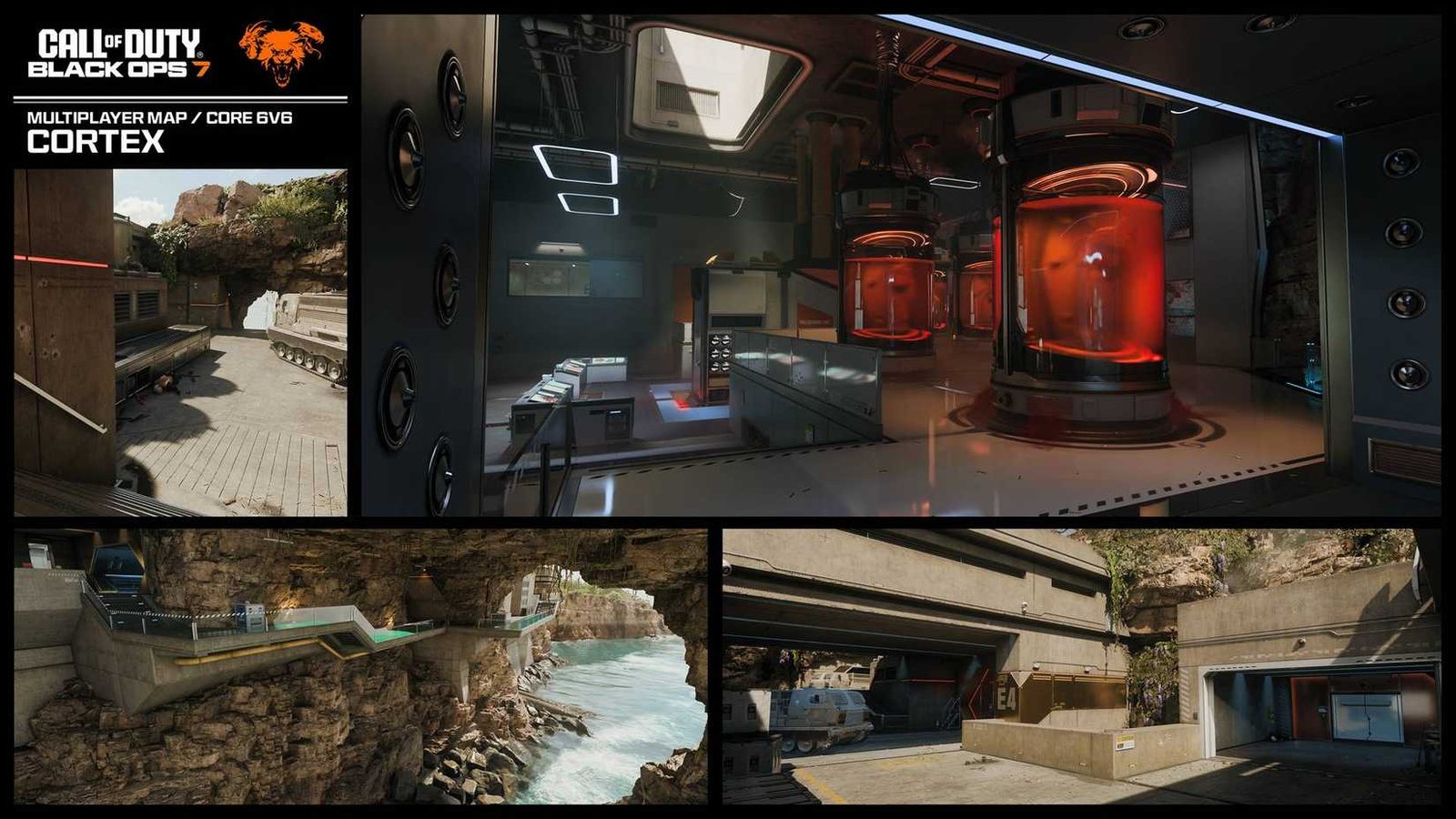
Shortly before the Call of Duty: Black Ops 7 beta began in October 2025, Treyarch detailed how the next entry in the storied first-person shooter series will be following a three-lane map design philosophy. This is a principle that began in the early days of the series, dating back to 2007’s Call of Duty 4: Modern Warfare, and on a list of fan-favorite Call of Duty maps throughout the whole community, chances are the overwhelming majority will come from older games that followed that structure to a T.
The Black Ops 7 beta proved that at least some of the locales in the full game, which is out Nov. 14 for PlayStation 5, Windows PC, and Xbox Series X, will follow that theory closely, with at least four of the six playing like true three-lane maps. In a chat with both Matt Scronce, design director on Black Ops 7, and Yale Miller, senior director of production, I asked how the approach to three-lane map design has changed over the years.

“I think [the approach] slightly evolves and continues to be refined, but I don’t know that the rules necessarily change,” Scronce told Polygon in a recent video call. “Much like myself and Yale, Phil Tasker is our level design director and has been here since Call of Duty: World at War, so he’s been involved in our greatest — and our not so greatest — maps. Every single one has had his hand in it, and he’s created the rule book and the bible for what is a signature Treyarch map. That is those power positions, every lane needs a purpose. If you’re working with a symmetrical map, you want to have symmetrical cover points.”
Miller elaborated by revealing the key aspect to nailing map design is playtesting each and every one constantly. “Playtesting is the other piece, and a willingness to see that because of X, Y now has a problem, so we need to make a change. Toshin [a Black Ops 7 beta map] is a prime example of this.”
For those unaware, Toshin has undergone a minor change from beta to launch, where a doorway at the top of the wrecked train is now open, allowing for players to flank inside, and part of the mid-section of the train has been ripped open, providing another sightline through the map.
Scronce explained: “The team had tried a few different things to open up that center lane [on Toshin] but they couldn’t find the right approach. It just so happened to line up that during the beta they came up with this configuration with the crashed train that led up to the top lane and we were like, ’Okay, this is the one.’ I wish we would’ve thought of this a month ago, but at least it was before launch.”
Expect the team to maintain this willingness to alter and adapt maps based on feedback throughout the course of the game’s lifespan too. It’s happened in the past with an adjustment to Moscow in Black Ops Cold War, after professional Call of Duty players advised on the amount of space available behind the police station, and again on Cartel, where the feedback online was that the tall bushes in the middle of the map were, well, too damn tall. So, as Scronce put it, they “took the lawnmower and whacked ’em down.”
Typically, even though changes are usually minor, they can have a major impact on how a map plays. “We want to avoid those ’what the fuck?’ moments for players, if there’s a spot where it’s too dark and someone can hide or this fence is slightly too low,” Miller used as examples for when the team would make adjustments such as improving the lighting or raising the fence very slightly. “Some of that comes from our own team playing the game as well, because we see things, look at the data, and we’re like, ’Yep, this is a really powerful position and it doesn’t have a counter because of X and Y.’”

I approached the pair with this line of thinking because, as someone who thrived in Call of Duty from around 2007–12, from Call of Duty 4: Modern Warfare to Black Ops 2, I was curious how both new movement tech and the faster pace of the series these days translates to thinking about map design. “Black Ops 6 is where we first introduced omnimovement, and there were a lot of learnings there,” explained Scronce. “I think our maps got better over the course of post-launch in Black Ops 6, but this means that all 18 launch maps in Black Ops 7 have all of those learnings factored in.
“With something like the wall jump mechanic in this game, a lot of the team also worked on Black Ops 3, so they’re very familiar with wall running and thrust jumping, and being able to peek over walls and buildings in those intentional wall jump spots. Also buildings with some spots where you can feel a little bit clever, maybe you can skip a ladder to shave a few seconds off, that sort of thing.”
“One of our big mantras for all Black Ops games is ‘fast and fluid,’” explained Miller after I asked about the tactical sprint change to make it a perk rather than granted to everyone by default. “I feel like because you don’t have that jerk at the beginning of acceleration and then your speed drops back down, it feels naturally fluid when you’re ramping into speed, like a proper acceleration curve, then you hit that flow state and you can get comfortable with the pace. It’s akin to how I felt running around maps in Black Ops 2 or 3.”

That change isn’t one that impacted map design much at all though, because as Scronce clarified, even though the player is slightly slower on average without tactical sprint, the base movement speed has been increased ever so slightly to counter this. Specifically, to get really into the weeds, sprint speed in Black Ops 6 was 2.55 inches per second, whereas in Black Ops 7, it’s now 2.85. “Level design is happier, and so are the people that think about it from a gameplay and math perspective, because tactical sprint creates more variation.”
Combined with every other aspect of multiplayer development, Scronce believes that Black Ops 7 is some of their “best work yet.” He says he feels “really good about where the beta landed and gearing up for launch, I think we’re going to be in a really good spot.” Miller followed that up by saying “it’s kind of all come together. We have feedback and things we want to improve, but the general full package has come together in the right way, the dish is good, now it’s about adding spices and changing little things. Everything feels like it’s cohesive and built together.”