There are plenty of memorable moments in Control Resonant. Seeing the twisted streets of Manhattan for the first time, a gorgeous area that’s covered in cotton candy-like mold, an astonishing boss fight against a floating head — there’s a lot to love, even if you’re less sold on the moment-to-moment action. But my favorite segment of Resonant isn’t any of its flashy moments designed specifically to blow your mind; it’s the game’s most stripped-down location.
Light spoilers for the second half of Control Resonant follow.
After spending a dozen or two hours exploring Manhattan, Resonant takes players underground. Dylan Faden dives far below the subway stations and sinkholes, finding himself in a strange location dubbed The Underpass. What could have been a momentum-killing location instead takes you through Resonant’s finest hours, proving that Remedy Entertainment might be better at making platformers than action games.

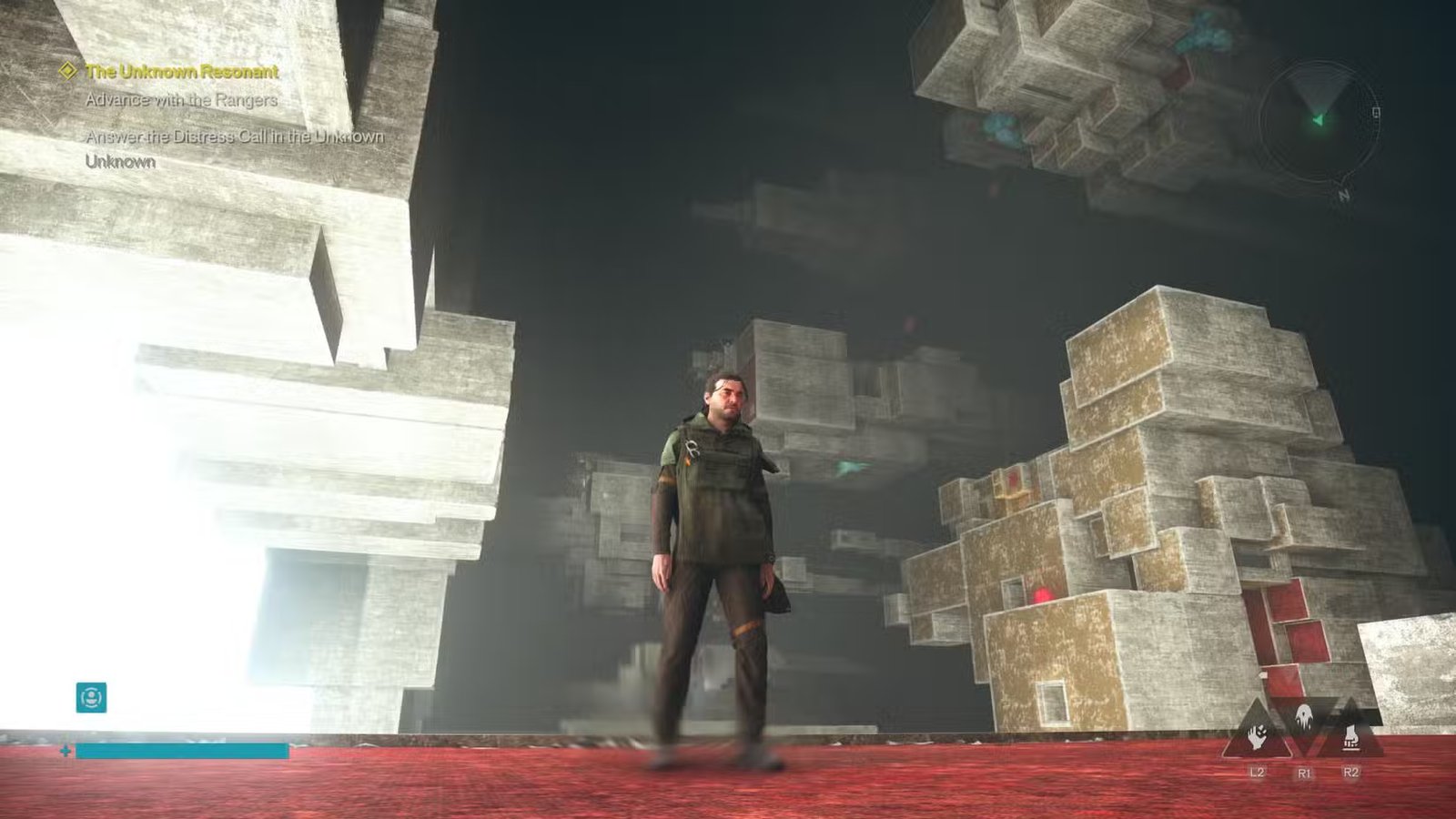
The first time you lay eyes on The Underpass, it’s a strange sight. By then, you’ve grown accustomed to Resonant’s visually busy open world. It’s lined with buildings and billboards. Dense packs of enemies roam the streets. There’s plenty of detail beyond the horizon to marvel at. Virtually all of that disappears in The Underpass. Instead, you’re left staring into a surreal, black abyss.
The Underpass is, essentially, a deconstructed city. It’s little more than a series of disconnected stone platforms and exposed pipes floating in dead space. You’re surrounded by a deep blackness on all sides that removes all sense of time and place that you’ve built up in Manhattan. It feels like an area that shouldn’t exist, a mistaken draft of Manhattan that was crumpled up and thrown in the garbage bin. Remedy plays with liminal spaces throughout Resonant, but The Underpass is where the team really finds its stride amid some louder visual twists.
It’s not just the unnerving look of the area that makes it memorable. It’s also home to some of Resonant’s best story moments. It’s almost a relief when Dylan stumbles onto a floating platform that contains an FBC testing site, something that at least feels tethered to humanity in an alien maze. That kicks off the primary missions of the area, which see Dylan learning more about the out-of-control experiments that the FBC has been running under the city’s nose. We previously got to see the results of that carelessness in The Oldest House, but The Underpass makes it clear that the bureau’s scientists are irreparably damaging the very fabric of reality.

Perhaps it’s no surprise that I loved my time in The Underpass considering that it’s the section of Resonant that’s least focused on combat. Hack-and-slash battles take a backseat to traversal, as Dylan needs to carefully chain together his powers to jump between islands. Remedy deserves its flowers here: The movement in Resonant is a real highlight. Combining air dashes, grapples, and hovers allows Dylan to cover so much ground that it feels like you could break the game. The Underpass is built to show that off, letting you fall into a Super Mario Odyssey-like flow state in a surreal jungle gym. Who knew that Remedy could make a great 3D platformer?
The Underpass marks what I see as a real turning point in Resonant, and perhaps in the entire Control series going forward. It’s where the by-the-book, open-world exploration of the early game takes a backseat to something much more creatively stimulating. The city, which was already looking very fragile, finally starts to come apart at its seams; you uncover a level of unreality that seeps out of The Underpass from that point on. That’s crucial for selling some of the best surprises in Resonant’s final stretch, including one jaw-dropping sequence that will convince you that anything is now possible in the compromised Control universe. Wherever Remedy goes from here, I’m seated for the ride.