


Ken coolly serves the hottest news stories and has played, we think, every game ever made.

Published:
Head to the Steam store page for Deadlock, and you’ll find a game that Valve says isn’t out yet. The stats, however, tell a different story: regular daily highs of 75,000 players, and an all-time peak of over 171,000. Impressive numbers for a game that doesn’t exist. What’s happening? The answer is that Valve’s new game, a fusion of hero shooters like Overwatch and Marvel Rivals with the MOBA structure of Dota 2 and League of Legends, is more of a complete experience than its developer lets on. It’s remarkably easy to start playing today, and you’d better get used to hearing the name, because when the floodgates finally open to all, it’s going to be huge.
Back as early as May 2024, rumors of a new Valve game started to spill across the internet. After attempting to quell the chatter for a few months, the Steam developer finally lifted the veil in August, telling its private testers that they were now officially allowed to talk about Deadlock. Built from the ashes of a previous Valve experiment called Neon Prime, Deadlock whisks players to an alternative-history take on New York called The Cursed Apple. Blending early 20th-century aesthetics with urban fantasy and magical realism, it focuses on a struggle between two powerful deities: The Hidden King and The Archmother.
At its core, Deadlock is a 6v6 multiplayer game with a simple format: move through the streets of its magic-infused city, battle the player-controlled heroes and automated minions of the rival Patron, push your way into the enemy base, and destroy the godly effigy within, all the while keeping your own side safe. The map, dotted with all manner of buildings and back alleys, features three main paths between the bases (known as ‘lanes’) down which the minions march. Each lane is periodically dotted with powerful defensive structures that require you to come prepared with sufficient equipment or backup to overwhelm them.

It’s a format that will feel familiar to players of League of Legends or Dota 2, one that traces its roots back to StarCraft custom mode Aeon of Strife and Warcraft 3 mod Defense of the Ancients. But unlike those games, which remain faithful to their RTS roots with a top-down view and mouse-cursor movement and aiming, Deadlock drops the camera down to street level. This is a third-person shooter with high mobility, slide tech, and wall jumping, creating dynamic action that feels closer to the likes of an Overwatch or Marvel Rivals – and a much more approachable prospect to an audience in 2026.
Valve keeps the identities of several of the key Deadlock developers under wraps – the most community-facing member of the team is known only as ‘Yoshi,’ named for Mario’s beloved dinosaur companion. Other confirmed names include Duncan Drummond and Paul Morse, the co-founders of Risk of Rain studio Hopoo Games. The enigmatic figure that sparks the most curiosity, however, is another famed for their long-time anonymity: ‘Icefrog,’ one of the lead developers on Defense of the Ancients and Dota 2, who has frequently been heralded as the careful shepherd of its balancing and the resulting meta.
Over the years, Valve has been hailed for its creativity, bringing us the likes of Half-Life, Portal, Left 4 Dead, and Team Fortress 2. Hearing that their next project was a mashup of established genres – live-service games, no less – might spark alarm bells. It certainly left me nervous, wondering whether it would feel stale and familiar. Then I played it, and any fears immediately melted away. Even in the heady days of 2024, when it was just getting started, Deadlock felt brilliant and fresh. The best pieces of its inspirations were lovingly plucked, and carefully combined with new ideas that fit the format.

Over the course of a Deadlock match, your chosen hero earns ‘souls.’ These both level you up, unlocking and upgrading your character’s unique skills, and allow you to buy equipment offering a wide range of stat-boosting passives and active effects at shops dotted around the map. You’ll score these souls when you kill an opposing player, but the majority of your earnings will come from clearing out the enemy minions that march in waves down the lanes, or more powerful neutral camps that await in the buildings between.
That’s very much classic MOBA stuff. Rather than the traditional Dota skill check of simply scoring the ‘last hit’ for a bonus, however, here you must earn your souls by blasting an orb that comes floating out of minions when they fall, and doing so before your opponent ‘denies’ them with a shot of their own. This embraces the precision and timing inherent to its shooter format, rewarding you for paying close attention to the entire battlefield instead of relentlessly attempting to ping down rival heroes with your attacks and spells.
Such smart thinking can be found in every inch of Deadlock’s design. The verticality of the Cursed Apple, and the sharp angles of its interstitial alleyways and tunnels, allows you ample opportunities to catch your foes off guard. Air jumps, wall jumps, and dash jumps let you get into or out of trouble in a flash, as long as you’ve got the stamina. Jump pads and ropes give less mobile heroes the chance to join in on the fun. My favorite feature is the ziplines that quickly carry you between home base and the current frontline in each lane, thus rewarding teams for establishing map control with fast movement.

You can’t run constant experiments without some failures, and Valve has been smart here too. Much as the Dota 2 team has shown willingness to toss out entire new systems that didn’t quite land, so it is with Deadlock. In its original form, games actually took place over four lanes. Whether that was a deliberate attempt to distinguish itself from MOBA tradition or simply a test of the format, Valve determined that it spread teams too thin, and redesigned the map in February 2025 with one lane removed. Sometimes, tradition is best.
While the gameplay wraps the immense popularity of MOBAs into a more approachable style, Deadlock’s true secret weapon is its roster of heroes. A cast that resonates with the people is essential if you’re going to stand up to juggernauts like Overwatch and League, and Valve has already proved that it’s still got the chops to match. Currently, there are 38 playable characters, which have traditionally rolled out in waves, and every single one is packed with personality that runs from their design through to their kit.
Cutthroat ex-crim Shiv strides in with his magnificent pompadour, sawn-off shotgun, and throwing knives. Elegant socialite Lady Geist feeds on the life force of others to power her spiritual skills. Masked magician Sinclair summons ghostly assistants, transforms his foes into rabbits, and copies the ultimate abilities of other players. Goat-headed bruiser Billy charges headlong into the fray, knocking his victims airborne and then smacking them about with a nail-studded baseball bat. One notorious, moustachioed man grapples through the air, flexes to deflect attacks, and wrangles opponents with his whip. His bio simply reads: “Jacob Lash is an asshole.”
Not everyone is human. Bebop is a big-hearted scrap golem who can pull other heroes in, slap a sticky bomb on them, and then uppercut them back into the enemy team as they explode. Punch-happy detective Abrams and arrogant fencer Apollo are among the Ixians, demon-like folk who came to Earth through one of the astral gates linked to other realms. Viscous is a blob of green goo – more specifically, a psychic sea anemone hailing from the Bermuda Triangle. I could go on and on and on, but the important thing to stress is that there’s a favorite here for every taste.
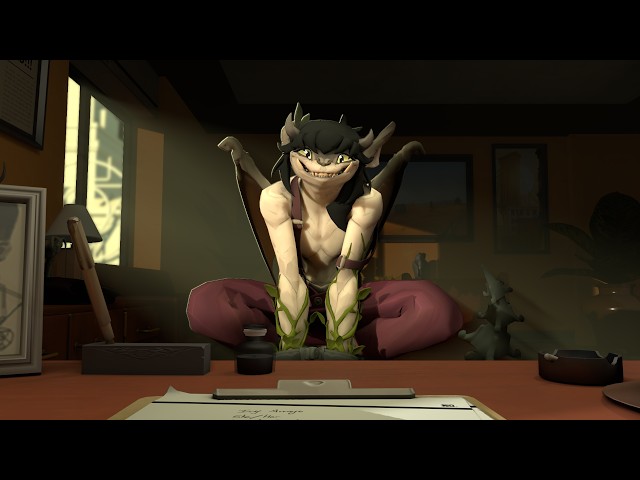
The in-match banter between characters is top notch as well, and helps enshrine their personalities and relationships while also subtly building the lore of the world. Valve is cooking hard, and it’s clearly already paying off, as you’ll find reams of fan art and animations crafted around the Deadlock cast. Among the early favorites was Ivy, a gleeful gargoyle vigilante who turns herself to stone to drop onto foes from above; the community almost immediately took to her striking look and exuberant enthusiasm from day one, showering her with love and affection.
As development has progressed, Valve has honed its focus, and more recent entrants have leant increasingly into specialist roles as a result. Despite this, you’re more free to play as whoever you choose than in the likes of League and Dota 2. There are certainly good team synergies between some specific characters, but for the most part you can pick whoever you like best. When queuing for a match, you must select at least three heroes you’re happy to use. The matchmaker will assign you one, but if you’d rather swap to another of your chosen set, you can do so before the game begins, providing no-one else has them selected.

Deadlock’s third-person action might be more approachable than your average MOBA, but it’s still a mechanically dense game, and it will only continue to grow more complex as additional heroes and items are introduced. Fortunately, Valve has an answer to this as well (aside from a suite of tutorials and a handy testing room): Street Brawl.
This more fast-paced, casual-friendly mode strips Deadlock down to the basics. Matches are 4v4, in a best-of-five set of skirmishes. At the start of every round, you’re able to add three items to your loadout, each one offered as a choice between three possible options. There are even some special pieces of gear exclusive to this mode. Street Brawl puts the focus squarely on learning your hero’s kit and executing in battle, while eliminating the potential for a good player to snowball an early lead out of control.
Valve writes that “Deadlock is in early development with lots of temporary art and experimental gameplay.” That’s true, and you’ll certainly notice that certain aspects of the map are much more polished than others, although every subsequent major update closes that gap significantly. Features are regularly being dramatically overhauled, and new ones introduced. A recent months-long saga saw the Spirit Urn, a bonus collectible, reworked multiple times, and it ended up turning into two completely standalone mechanics.

Valve also says that “access is currently limited to friend invite via our playtesters.” You cannot simply click a button on the Steam store to gain access. Despite this, getting permission to play Deadlock is remarkably easy. All you need is to ask a friend who’s playing – and there’s a high chance someone on your Steam friends list is – to click your name in game. Failing that, head over to the Deadlock Reddit page and you’ll find a dedicated thread where helpful people will get you through the door.
The next question is: Should you play Deadlock now, if it’s not finished yet? At this point, I’d say it’s absolutely enough of a ‘real game’ to warrant your attention, and getting in on the ground floor will help you establish your fundamentals before Valve throws wide the gates. With that being said, it is absolutely in the experimental stages, and I could understand wanting to wait until Valve stamps its official seal of approval and sends it out to the audience at large.
Consider Dota 2, however. That game’s full release never prevented the team behind it from making radical changes; we’ve seen everything from complete map redesigns to entire new gameplay systems that come and go over the years. Don’t suddenly expect Deadlock’s design to be locked in stone when early access begins in earnest, then, nor when Valve determines it’s satisfied enough to mark it as version 1.0. It’s simply not in the studio’s nature to rest on its laurels.
What you should expect, however, is Valve’s next true juggernaut, combining all of the effortless, elegant charm needed to foster an enthusiastic community with enough raw gameplay heft to boast some serious staying power. Mark my words: Once Deadlock officially debuts, it’ll be here to stay.