
Marvel vs. Capcom is one of the most beloved fighting game series of all time, with a legacy so strong that even after Marvel vs. Capcom: Infinite burned a lot of goodwill, many genre oldheads would probably still sacrifice their firstborn for a new installment. In this way, Marvel Tokon: Fighting Souls always had an uphill battle: How could a new Marvel tag fighting game possibly live up to finger-breaking Magneto infinites and legendary tournament moments that people still reference decades later?
While we haven’t had enough time to dig into Marvel Tokon to form a final, definitive opinion on the game — early review codes weren’t sent out to the press — it’s clear that, for better and worse, it’s best to put MvC as far out of mind as possible. Yes, this is a 2D tag fighter with Dr. Doom, Spider-Man, and Storm, but in terms of meat-and-potatoes gameplay specifics, it couldn’t be further from that older series’ ankle-breaking speed.

Marvel Tokon is clearly going for something entirely different, and as such, deserves to be judged on its own merits. The issue is that, even viewed with an open mind, it has a lot of problems as a competitive fighting game. Tokon has a gorgeous art style and a potentially sharp story mode, but between sluggish central gameplay and massive issues on PC, this doesn’t seem like the kind of heroic offering that will have hardcore genre enthusiasts gushing.
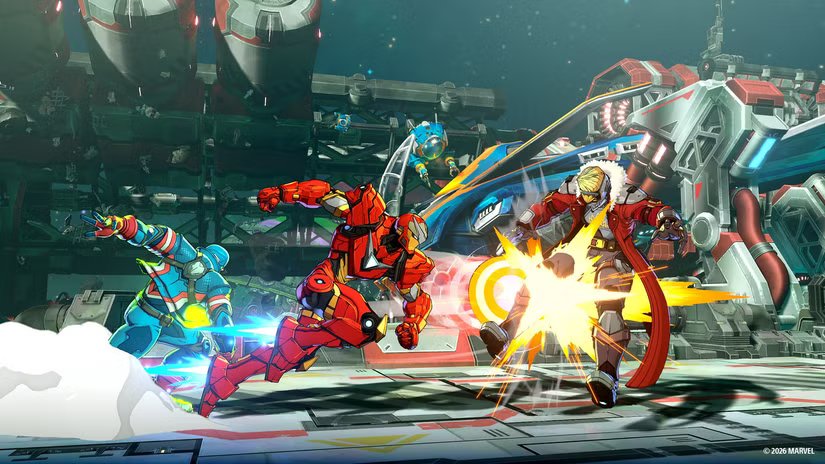
That doesn’t detract from the game’s merits, though. Marvel Tokon: Fighting Souls is a visual marvel, and Arc System Works (known for Guilty Gear, Dragon Ball FighterZ, and Blazblue) lives up to its own lofty standards. Much of this starts with the characters, which take old school comic designs and apply a subtle but sharp anime sheen (except for Danger, who has been hit with a full Moe beam). Where things really get impressive is how these heroes and villains move, leaving behind Ben-Day dot afterimages, as tasteful old school flourishes combine with over-the-top kamehameha-tier theatrics. Deadpool is a perfect example of how much love went into crafting these characters’ visual identities, unleashing a fourth-wall-shattering barrage of fighting-game references that allude to everything from Super Smash Bros. to Street Fighter: The Movie.
This presentation comes alive in the story mode, which, at least through the limited progress I’ve made in the first chapter, seems quite neat. The basic setup is a familiar one — it’s basically a tournament arc — but award-winning comic writer Kieron Gillen leaves room for small character moments. The premise is that a big-bad, the Champion of the Universe, comes to challenge Earth’s finest fighters for a high-stakes bout: if humanity loses this prize fight, the planet gets destroyed. There are five playable storylines, each centered on a different team of four, with the narrative presented through a mixture of motion comics and literal anime cutscenes. This is admittedly the part of the game I’ve had the least time with — I’ve played about an hour compared to sinking roughly 20 hours into the multiplayer betas — but the mode has quite a bit of promise.
However, if there’s an issue that severely hampers Marvel Tokon both inside and outside the story mode, it’s that the game is currently a mess on Windows PC. While the issues aren’t quite as bad as during the recent beta, this port is very poorly optimized, leading to frame drops. Even with my RTX 3080 graphics card, it is almost impossible to get a fully stable 60 FPS regardless of settings. According to early reports, even users on high-end machines are experiencing unavoidable micro-stutters.
Even if you can run Tokon perfectly on your own setup, these technical issues are so commonplace that you’ll almost certainly run into problems when playing multiplayer. Basically, because of how online play works, if your opponent is getting a low framerate, it will lead to jumpy gameplay even if you share a perfect internet connection. These performance issues seem to be the main reason why Tokon is currently sitting at a dismal 36% user rating on Steam. While there’s been speculation that Sony’s anti-cheat software and forced PlayStation Network integration are why the game is running so poorly on Windows PC compared to PS5, we’ll have to wait and see if PlayStation addresses these integrations.

However, even if you’re playing on console, Marvel Tokon is a sluggish fighting game that feels at war with itself, attempting to appeal to newcomers and genre veterans without fully satisfying either. Nearly everything about its core movement is slow, seemingly so that beginners won’t be “overwhelmed” compared to the quicker-paced games Arc System Works used to make, like Blazblue or even Dragon Ball FighterZ. Sprinting and air dashes aren’t particularly fast, and attacks feel quite lethargic, with a good amount of startup and recovery. At the same time, this is a four-versus-four tag fighter that lets players fill the screen with projectiles and massive hitboxes, something that high-level competitors are already using to set up criminal sequences and wonky mix-ups.
Basically, while elements of the game feel similar to something like Granblue Fantasy Versus, which is very beginner-focused, this is also a tag fighter, which tends to allow for high-power-level nonsense. The result is awkward, as it has neither the more tactical pace found in ground-based games nor the speed and skill expression of older air-dash-focused fighters. Those who have bounced off more recent Arc System Works-published titles like Guilty Gear Strive or DNF Duel will likely have similar complaints here.
Another issue is that it seems a bit too easy to perform overbearing pressure sequences that give your opponent little room to interact. While there is a mechanic called “Crossover” where the defender can spend assist meter to push their foe back, the attacker can react with their own Crossover (which I’m sure high-level players will be able to do consistently quite soon) and then perform a combo. Hopefully, players will find ways around this, perhaps by using a universal armored move called Assemble Counter, but at least right now it seems like skilled play may involve sitting in block for long periods while waiting to get your turn back, which isn’t particularly exciting.
Marvel Tokon may become more compelling with time, especially as players figure out creative ways to use its tag mechanic, but even judged on its own terms, the game lacks a cohesive identity at the moment. Between design issues that will likely alienate some hardcore players and brutal performance issues on Windows PC, this launch has been far from super.