
No Rest for the Wicked 1.0 is going to look very different from the action RPG I’ve poured dozens of hours into during its early access. Developer Moon Studios has cast out its existing leveling structure, which bore close resemblance to the likes of Dark Souls, in favor of a completely new class system. That’s led to concerns that ARPG min-maxers will find the perfect ‘meta build’ and limit variety, but Game Director Thomas Mahler believes the best answer to this is simply to offer even more choice.
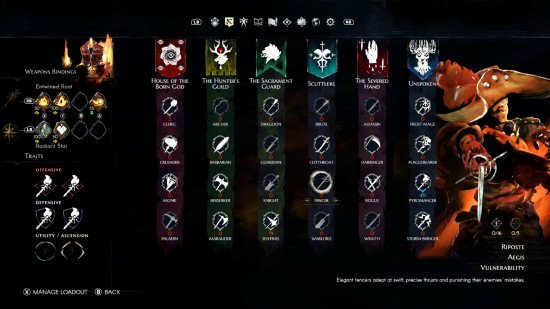
The class system is at the heart of the No Rest for the Wicked 1.0 update, and Mahler explains that it was Moon Studios’ answer to the issue of “numbers going up without feeling much difference.” The old attributes are gone completely, with your main stats now defined by the new Cerim Cores. These can be swapped out at any time, and even overloaded beyond your usual capacity at the cost of taking more damage. Alongside those is a network of 24 classes, which have been designed to give you “entirely unique ways to play Wicked,” and should enable you “to come up with just about any class you could conceive playing within an ARPG.”
Importantly, you aren’t locked into just one option. The ‘class’ you are currently playing is defined by the weapon you’re using: holding a spear makes you a Dragoon, while grabbing a scythe transforms you into a Harbinger. Each class has a specific resource earned by using it, which allows you to unlock a list of traits that provide passive character augments, and runes that bestow your active abilities. Unlocking these traits will allow you to use them across the other classes, meaning that you’re rewarded for experimenting with a range of fighting styles.

Just glimpsing at a couple of classes in action makes it rapidly apparent what a big evolution this is to No Rest for the Wicked’s already compelling combat. The Dragoon builds up focus with precision long-range strikes, setting up floating lightning lances that home in on targets as you leap directly onto their heads. There’s a focus on predicting where enemies will be and precisely aiming your moves to meet them, and you can even hurl a giant spear of lightning as your coup de grâce.
The Assassin, meanwhile, takes advantage of overhauled, smarter enemies with traits that let you see your foes’ vision cones while stationary, then rush in, crouched, to deliver devastating backstabs with bonus damage, or slink into the shadows to become fully cloaked while pressed up against walls. You can even knock on the stone like it’s Metal Gear Solid, creating a distraction to exploit. “We’ve never really seen stealth done right in an ARPG,” Mahler remarks. Now that’s about to change.
Everything can then be brought together from your trait collection. You can equip two offensive traits, two defensive ones, one utility option, and one ascension. “That’s how you stop playing our Assassin or our Dragoon, and start playing something that only exists on your character,” Mahler explains. That’s no understatement: “With 384 traits across 24 classes, there are over 168 billion ways to fill your trait slots. With the weapon choices on top of that, you’re looking at more than four trillion possible builds.”
Mahler admits this is an impossible balance ask. “Yes, there’ll likely be builds that’ll be easier to play for newcomers that a lot of people will just copy because they’re simple to play and grant good DPS.” Instead of trying to fight this, he remarks, “I think the only way to combat that is to keep the game update and give players so much choice that the meta will naturally shift over time.”
It’s an approach I’ve already seen work in another ARPG – Path of Exile. Grinding Gear Games does its best to address particular balance outliers from season to season, but ultimately with so many potential skill and passive tree combinations, it’s impossible to catch everything. Importantly, though, you’ll see much less dominance from specific meta builds in the PoE community versus the likes of Diablo 4, because there are so many potential ways to demolish endgame maps that coming up with new, creative builds is simply more fun.
“People have been playing Diablo 2 for, what, the past 20 years? And given the runewords and everything, I’d argue the game still isn’t ‘solved,'” Mahler continues. He even says, “I’m sure people will use AI on top to find the best possible outcomes, but at some point we just gotta stay realistic and be okay with some builds being pretty fucking good and some others less good, but still pretty good.”

“And ultimately.. Who cares?” Mahler asks. “If people find some really good build and want to share it with others, more power to them. You’ll very likely still get tickled wanting to try the other traits and runes and so on anyway.” As someone who already really loved No Rest for the Wicked, I’m more than willing to trust in Moon Studios, and I’ll admit that a large part of my main playthrough’s build did end up fairly one-note. I’m excited for that to change.
No Rest for the Wicked 1.0 is set to release in March 2027. “The class system is the heart surgery, but it’s far from the only thing we’ve been working on,” Mahler remarks. Moon Studios estimates that the 1.0 update will “roughly double” the amount of content, from brand-new zones to an expansion for the town of Sacrament, a selection of fresh enemy factions and bosses, overhauled loot, gem fusions, and a lot of polish and optimization. I can’t wait.