


Lauren spends most of her time dead in League of Legends, or equally as dead in Valorant. Don’t ask her about Vampire: The Masquerade.
Published:
Total War: Warhammer 40k has, in many ways, an impossible job. How exactly do you reimagine a full-blown galactic conflict spanning millions of years in videogame form? How do you include all of these factions – whether it be the Imperium’s myriad Space Marine chapters, or the Xeno tides of Tyrannids and Necrons – in a single game? How do you capture the sheer brutality of war on a granular scale, while simultaneously showcasing its wider effects? I was hoping Creative Assembly’s latest would answer that question, and in many ways, I think it has.

It’s worth noting straight off the bat that Total War: Warhammer 40k, on release, does have its limits. “The scale [of 40k] is bananas,” Battle Product Owner David Petry tells me at Gamescom. “It [wasn’t] going to feel right to approach [TWW40K] as ‘this is the galaxy.’ This is a segmentum that’s fighting a segmentum. We need to find the right sort of feeling that makes [you feel] close to the world so that it’s immersive, without creating too much of an abstract sense of like, ‘we’re too far away.’ We want you to be able to feel connected to the battles and everything that’s happening.
“Where we’ve kind of settled is to treat each campaign kind of like a solar system,” he continues. “You are within a single campaign, moving between a number of planets in a single solar system, and that can be a single-campaign experience. But that’s then part of a bigger, crusader theater. At the moment we’re focusing on Armageddon, which is going to be the grimdark cherry at the end of this terrifying cake of death – I haven’t said that out loud, ever. It’s a terrible, terrible cake.” We all burst into a fit of giggles.
The focus, then, is to take a “known chapter” and “go on these amazing adventures in single campaigns, attached to bigger campaign theaters.” It helps keep expectations manageable, while simultaneously making you feel like you’re part of a wider world. In some ways, this approach feels vaguely reminiscent of Helldivers 2, where your actions have a wider impact on the theater of war around you. I’d argue that this is the best approach Creative Assembly could have taken; it gives you the perfect blend of granular, nitty gritty action and overarching, meaningful stakes.

The instance that I played was the game’s tutorial, followed by a little bit of free gameplay. In true eleventh edition style, it’s Space Marines versus the Orks, where the player takes charge of the Emperor’s finest. Your job is pretty simple: destroy the Orks, plain and simple.
The gameplay will feel immediately familiar to anyone who’s played a Total War title – move your army here, attack this thing, do this other thing – and the scale is impressive. My crew emerges from the Warp in their cathedral-esque ship, bound for Umbra Prime. I’m greeted by a zoomed-out view of the planet, which highlights the location of the shipment I need to procure with a huge Space Marine. You can spin the planet around to get a good look at it, and I’m immediately struck by not only the terrain detail, but by the fact it’s already been carved up into various faction-owned territories. It’s genuinely impressive.
I send my Space Marines off to deal with the Snaz Braggerz, who appear to have illegally acquired my cargo. I choose to attack, triggering that signature Total War attack screen, but the UI has got an upgrade to show off more of both armies’ troops. It gives me a bit more info at a glance, while not being overwhelming.

When I’m down on the ground, I remain stunned by the game’s sheer sense of scale. I can zoom in and lurk behind my Space Marines, using the camera to act as though I’m one of the fighters, as opposed to an omnipresent, mouse-wielding games journalist. The Marines are hulking, titanic warriors, and while the Orks are nothing to smirk at, they feel small by comparison. Their busted mechanical terrain is huge – at one point I dive behind cover, and zoom in just to get a sense of really being in the trenches. It has Space Marine 2’s sense of immersion; a sense that war truly is everywhere.
As I shred through the Xenos like any good Space Marine should, I can coordinate attacks to pincer them in, and drop air strikes to decimate their lines. Said heavy weapons take a little while to load up, simulating the idea of spacecraft taking a moment to relocate to the battlefield, meaning you have to be clever with your timings. A personal favorite was the morale system, which causes enemies to begin to scatter if you either kill their leader, or shred enough of their troops. In this instance, I focus on the Orks’ commander, and after he’s defeated they scatter, making them easy for my gunners to pick off.
The tutorial does a fantastic job of really introducing you to the world of Total War, and while I still think it relies on a little bit of pre-assumed 40k lore knowledge, I think it’s a generally good taster of what to expect with the wider universe. That’s kind of my entire experience with TWW40k as a whole. I’ll admit that I’ve played more strategy games since joining PCGamesN, but when it comes to titles that are as expansive as Total War or Europa Universalis, I generally find myself running for the hills.
Creative Assembly’s latest, however, does feel more accessible – the tutorial mission genuinely made things understandable, and I didn’t feel overwhelmed by a slew of menus. When I went into the freeplay mode, I actually felt like I understood how to capture an objective, and how to actually strategize without simply hoping for the best.

This helps assuage some of my fears about TWW40k. Warhammer 40,000, as a franchise, has seen a parade of games released over the past couple of years alone – Mechanicus 2 takes a more XCOM-style approach to the action, while Space Marine 2 is much more action-heavy, with some serious hacking and slashing. The interest is clearly there for Warhammer videogames, but to many, Total War could feel impenetrable. It’s something Lead Designer Joy Dey says that Creative Assembly actively thought about when designing both the tutorial and the game’s UI.
“We are expecting a lot of players who haven’t played Total War before to be interested because of the brand,” she says. “That’s how we built the tutorial – we’re trying to cater to new Total War players, and we also want returning players to get familiarized with the new things in this game, and we’re also trying to onboard the players to the lore.”
Speaking of the likes of Space Marine 2, here, there’s clearly been some learnings from Saber’s co-op action titan. A quick glance at Total War Warhammer 40k’s customization menu – which loads up as you enter a new campaign – proves that you really can create the Space Marines of your dreams, whether they’re lore-accurate or, in my case, neon pink. You can also generate names for your armies, which I’m sure won’t end badly at all.
Petry and Dey inform me that the “pink line” is relatively common, which I feel vaguely attacked for – I’m pretty sure I did it first. But either way; Creative Assembly’s taken a leaf out of Saber’s book here, and customization looks good.
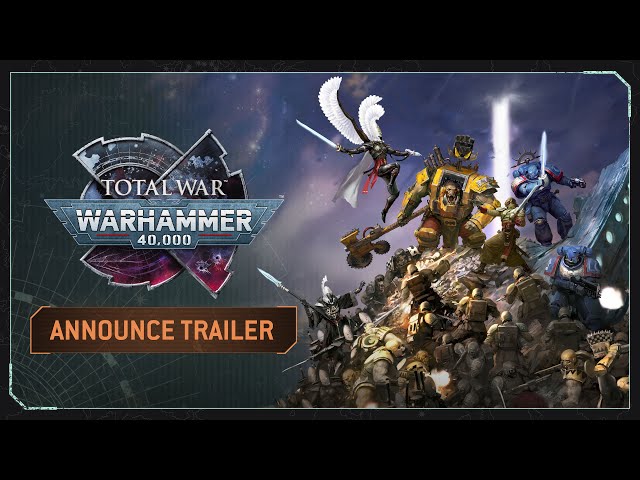
Total War Warhammer 40k achieves what it hopes to: it distills the Warhammer 40k universe down into manageable chunks that allow for both nitty gritty strategy gaming, alongside more narrative-heavy campaign-driven elements. The size and scope still feel huge, but not to a level where it’s unwieldy or overwhelming.
While the distinct lack of Chaos factions does feel like a slightly odd choice for launch – we have the Space Marines, Astra Militarum, Orks, and Aeldari – Petry does promise that they’re coming further down the line, alongside my beloved Necrons. That’s the only real criticism I have of TWW40k, however, and even then, I’m excited to see how it all evolves – in many ways, that feels like it’s part of how grand strategy games operate.
I ask, jokingly, if the Emperor would like TWW40k. Petry laughs: “I think that the Emperor senses that there is heresy, and as long as we are out to stamp it out – to burn, to purge – he may well approve.” There’s a lot of that here, so to my mind, he approves.