


Lauren spends most of her time dead in League of Legends, or equally as dead in Valorant. Don’t ask her about Vampire: The Masquerade.

Published:
Can you resist the allure of power? Could you ignore the voice in your head, whispering sweet nothings? It can give you the ability to bend reality to your will; to warp and twist forgotten magics into weird and wonderful new forms. Yet, with that power comes an inherent darkness: an acknowledgement that you’ll have to break some rules to get what you want. That’s the eldritch drama that Warlock, Wizards of the Coast’s upcoming D&D-set RPG, tasks you with exploring – and I watched Kaatri grapple with it in my hands-off Gamescom preview.
Warlock is the first big Dungeons and Dragons game we’ve seen post-Baldur’s Gate 3. The brainchild of Invoke Studios, with help from Wizards of the Coast, it looks very different from Larian’s CRPG epic. Trading out the turn-based combat for more action-heavy, RPG-style gameplay, you play as Kaatri, a newly pacted Warlock that’s chosen the mysterious Tasha (of Tasha’s Hideous Laughter and Tasha’s Cauldron of Everything fame) as her patron. Or, perhaps more accurately, Tasha has chosen her.
While the exact details of our grisly quest remain a mystery, Gamescom gave us our first deep dive into Warlock’s gameplay, with a focus on combat and traversal. What I saw was a slightly extended version of the Opening Night Live trailer, and while I think a few elements need a little bit of tuning up, I see the foundations of a solid Dungeons and Dragons experience lurking beneath the surface.

Let me start with the demo’s primary focus: combat. One of the things Baldur’s Gate 3 did so well was its translation of the TTRPG’s spells and cantrips into tangible, genuinely exciting in-game abilities. Given that spells like Eldritch Blast and Misty Step are iconic in their own right, I was interested to see how Invoke reimagined them in its own style. Would we see Larian’s iconic green lightning bolt again? Or would the studio do something new?
I was pleasantly surprised by just how readable each spell was, and by the fact that they aren’t just straight copies of Larian’s. Misty Step is accompanied by an eerie violet mist and some silver sparkles (given Warlock’s entire brand is purple, this makes a lot of sense), while Eldritch Blast is a wispy, spiraling beam of blue and black energy that you can charge up for extra damage. It’s a refreshing, new take on the spells we know and love, and I’m glad Invoke has taken the time to truly make them their own.
You can also use your spells and rituals to interact with the environment. As she ventures out into the open world, Kaatri summons a Downpour that puts out fires and drenches her enemies – and she does it via ritual cast, which pulls up a screen where she adds grisly spell components to a ouija-esque board. She uses her telekinetic abilities to lift up a lamp, using the oil to burn away various wooden boxes that are blocking her path, before dousing said flames with water. I’m informed there are myriad other ways the player could have approached that latter situation, too: Tasha’s Leash could have come in handy here, or a blast of Gust of Wind.
While Warlock is a more linear experience than Baldur’s Gate 3, it’s clear the team has considered how to best encapsulate D&D’s sense of endless possibility into its RPG. I doubt we’ll see the same scope as BG3, where the sky truly was the limit, but there’s still a lot of flexibility here.

Spells are just a single part of Kaatri’s arsenal, however. Just as with the tabletop game, you can take a more melee approach to combat, although Invoke warns that this probably isn’t the best route. In this demo, Kaatri is armed with a sword (I’m unsure whether this is a conjured weapon or a standard one), and you can upgrade your weapons and armor as you progress through the game.
It’s all relatively standard stuff here; you can hack away at your enemies if you can get up close and personal, and then interweave your spells to do damage from afar. Once again there’s a level of flexibility to this, and I’m excited to start chaining my spells in with the melee combat for a satisfying fusion of magic and melee.
On the other hand, I do think the combat looks a little rough. As I mentioned, this demo was hands-off, so I didn’t actively play the game myself. While the spells and sword swooshes all look good, there’s a lack of fluidity when Kaatri switches from sword to magic, and there are little pauses before she dodges, where it looks like the animation takes a moment to wind up. At the moment, it feels like there’s a lot of dead time during combat sequences – the final, ogre-esque boss is a clear example of that, with a large portion of the fight spent darting around and circling him versus actual thwacking.
It’s worth noting, though, that this sequence is part of a gameplay demo; to really show off Kaatri’s abilities, Invoke may have deliberately taken a slower, demonstrative approach to the combat, as opposed to chaining off dozens of attacks while players look on, vaguely confused. Additionally, Warlock is still very much in the development phase, so there’s plenty of time to tidy up those animations and streamline the flow of battle.

I also got a sneak peek at Darkon, Warlock’s expansive open world setting. Invoke’s Vice President and General Manager, Dominic Guay, confirmed that, while Darkon isn’t a Forgotten Realms setting (it’s part of Ravenloft, WoTC’s gorgeous gothic horror universe), Kaatri does in fact hail from Faerûn – the land where Baldur’s Gate 3 takes place. “She gets thrown into Darkon in the Domains of Dread,” he tells me, noting that Darkon has existed for a long time, but is “a bit off a deep cut and is less known. It’s a bit of a sweet spot for us, because we had all of the lore, but we weren’t necessarily doing a world where fans of [D&D] would have an advantage; where they’d come in and go ‘okay, I need to go there, I know everything.'”
As someone who does know her fair share of Ravenloft lore (what can I say, I’m a vampire person), I’m genuinely excited by Invoke’s interpretation of Darkon. It’s vaguely reminiscent of the grit and grime of the early Dragon Age games, with the ruined village area reminding me a little bit of the Darkspawn-ravaged Ferelden that we see in Origins.
I’m interested to see just how expansive Darkon is – it is its own domain, similar to that of the Forgotten Realms, but given that Warlock is a more linear story, I want to see how Invoke chooses to make use of the setting and environments. You can pick up sidequests and wander off the beaten path, and I’m hopeful that Invoke embraces the delightful, palate cleansing weirdness that D&D sidequests often generate. After all, why do the main storyline when you can fight a random door that looked at you funny?
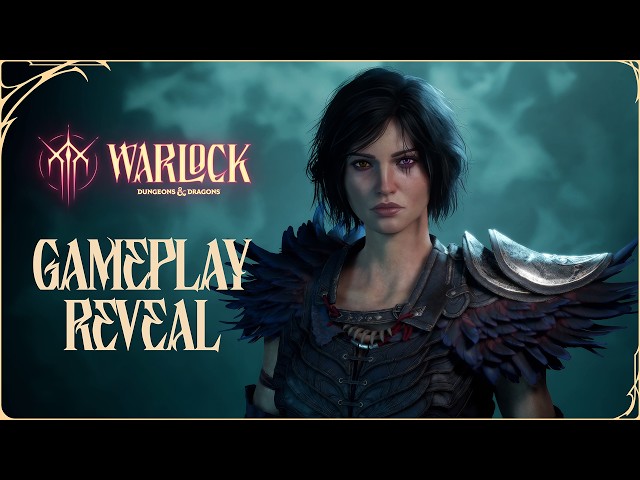
With a little bit of polish, I genuinely believe that Warlock can be yet another great installment in the D&D videogame saga. Invoke has picked the perfect class, and crafted a world that has enough grit to feel uniquely Ravenloft, without falling into the trap of being generic. Moreover, I’m just excited for another high fantasy, narrative-driven, single-player RPG. I didn’t get on with Dragon Age: The Veilguard, and while The Blood of Dawnwalker is very much my kind of game, I struggle to find the time to plow hours and hours into new adventures. Warlock really feels like it can finally sate my fantasy woes, even if I’ll need to wait until 2027, and sell my soul to do so.