


When he isn’t writing for our sister site Wargamer or painting Warhammer, Tim is stuck trying to complete Blue Prince.

Published:
OwlCat Games is one of the most focused, niche studios working in the industry, with a gameography filled with isometric CRPGs in the vein of ’90s classics like Baldur’s Gate and Fallout. The currently Cyprus-based studio celebrated its 10th anniversary on June 6, which gave me a perfect excuse to talk to creative director Alexander Mishulin about the studio’s history and its future, the upcoming BioWare-style action RPG The Expanse: Osiris Reborn.
OwlCat Games started small, with just 15 members. The kernel of that team met at Nival Interactive working on a variety of games including Heroes of Might and Magic V; “another part of the team joined when we were making Allods Online and Skyforge”, Mishulin recalls. “After two MMORPG projects, each lasting five years, we were tired and we wanted to make something that brought a lot of us to the industry – a great CPRG”. The massively successful Kickstarter campaign for Pillars of Eternity in 2012 showed that there was an audience hungry for games in this classic genre.
OwlCat’s debut game, Pathfinder: Kingmaker, is adapted from an existing tabletop RPG campaign, chosen because the team were so impressed by it’s combination of classic adventuring and unique nation-building: “It allows you to create something of your own and protect it, feeling not only your power, but also your responsibility for your fledgling nation”, Mishulin says. As well as running a normal adventuring party, the player has a kingdom-building mini game, complete with weighty political decisions and entire armies to command.
It was an incredibly ambitious project for a new studio, something Mishulin readily admits. “We underestimated the scope and complexity of the game, and while we cut quite a lot of features, it still was a very ambitious project”, he says. The team “strived to provide our players with a lot of choices, a lot of paths through the game, and capture all the fun we had at the tabletop – and it seems to me we did it”. But the trade off for not compromising on that ambition was “releasing the game in quite a buggy state”.
It’s something I’ve heard before, when I interviewed executive producer Anatoly Shestov about the studio’s debut Warhammer 40,000 title, Rogue Trader: given the choice between putting all their creativity into a game, or limiting the scope to try and make it bug proof, OwlCat goes for the more ambitious approach. “We are still fighting this battle with bugs”, Mishulin says, “I hope that each new release will be better in this regard”.
Perhaps it was the choice to make a game based on a tabletop campaign that the developers already knew and loved which made such an ambitious project possible. “Tabletop experience can drive and unify project vision”, Mishulin says. “For both Pathfinder games the entire team played the respective Adventure Paths – it helped tremendously by bringing the team together, sharing an experience that we were going to bring to the players, the feeling of guiding the whole nation or leading the last desperate crusade against demon hordes” in the studio’s second game, Pathfinder: Wrath of the Righteous.

“Many of the great ideas, stories, and side quests for those games were born during those playthroughs”, Mishulin says. Unique game systems came from the tabletop as well. “The first that comes to mind is the camp mechanics in both Pathfinder games: at the table you always prepare for the rest, try to find a good place, set up guard rotation, browse through the loot and discuss your further plans in great detail. In computer games all these activities are usually skipped, you press R or something and voila! Everybody is at full health”. The camp in the Pathfinder games has “banter between companions discussing recent events and upcoming plans, and rest preparations – preparing meals for the team, masking the whole camp to prevent potential encounters, posting guards to spot incoming danger before it attacks”.
From an initial team of “around 15”, Owlcat has grown to more than 600 members, which has necessarily transformed how the studio operates. “In a small team you can discuss anything in a matter of seconds, just come to the right person and you can try something out at their place, and your colleague nearby can jump in and support either one of you or suggest a third idea”, Mishulin reminisces, “it is quick, it is cohesive, everybody knows what you are doing and why you are doing it – there is a huge sense of camaraderie and responsibility to one another”.
“As you get bigger you have to establish processes, but you can make so much more”, he continues. “Projects become more ambitious, and in our case we eventually began to make two projects simultaneously”. Another major change was forced on the company by COVID. “We feared that productivity would drop significantly, that the creativity that stems from a lot of spontaneous discussions at coffee breaks would vanish”, Mishulin says. “Actually productivity rose, and we had to monitor that people weren’t burning themselves out” working beyond their actual hours.
The game that emerged from the enforced isolation of COVID lockdown was Warhammer 40,000 Rogue Trader, the studio’s first foray into the grim darkness of the far future, and another title that was inspired by a long-running RPG campaign. Its sequel, Dark Heresy, is nearing completion. Despite veering off into the idiosyncratic Warhammer 40,000 grimdark science fantasy universe, both games are faithful to the OwlCat’s core CRPG style, which Mishulin summarizes as “great stories with great companions, and an approach to the storytelling in the cRPG that is both companion-centric and filled with choices and consequences, big and small”.

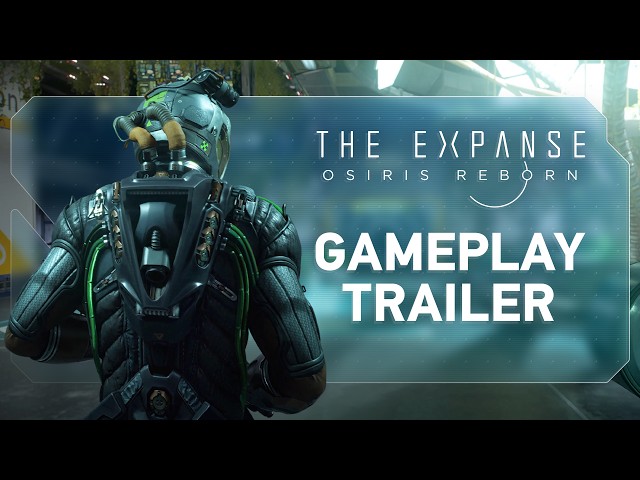
A far bigger departure is just on the horizon for the studio: The Expanse: Osiris Reborn, an action RPG with more in common with BioWare’s Mass Effect than BioWare’s Baldur’s Gate. “We had to learn a lot of things from scratch”, Mushilin says, “there are obvious ones like the new engine, the cover shooter gameplay, and completely different pipelines for production”. But it also requires a different mindset. Mishulin calls it “a far more cinematic game, so we had not only to build our own cinematics department, but also write the game in a completely different way”. He admits “we are still fine-tuning our writing in this regard”.
Mishulin says that, despite the switch in genre, the team are still trying to stay true to what makes a “true OwlCat experience”. “The focus is on companions, who are present and integrated into gameplay more than in other games of the same genre, and on the narrative, with choices and consequences”. He calls it “a different way to tell our story” – but fundamentally, still an OwlCat story.
For those who might fear a BioWare style pivot that sees OwlCat abandon CRPGS, Mishulin says “we will continue to make CRPGs because we love them”. “We do not want to become stagnant”, he adds, “we will be trying different approaches for our RPG games, trying to find the best possible fit for the idea of the game”. The studio is still “striving to maintain our initial core, our values: we want to create the best possible RPGs, we like them, we play them, we get inspired by them and we want our games to feel the same, that we would enjoy them ourselves and hope that they will inspire someone else to create even better ones”.