
Eyes fixed on his feet, hands stitched to the inside of his trouser pockets, Pep Guardiola dragged himself onto the Amex turf before Darren England had even brought the whistle down from his mouth.
No handshake for Fabian Hurzeler. No word spoken to a single player over the next three minutes. No sense of direction as he wandered aimlessly into the middle of the pitch before dutifully applauding the travelling fans behind the goal.
It encapsulated Manchester City’s final half-hour against Brighton & Hove Albion, a blur in which they showed no emotional spike and simply acquiesced to their fate.
This 2-1 defeat, following the 2-0 home loss to Tottenham Hotspur last weekend, leaves City on three points after three games. It is the lowest points tally of Guardiola’s career at this stage of a league season and the first time they have been below Manchester United in the Premier League table after three or more matchweeks since September 2021 — there have been six managers in the dugout at Old Trafford in that time.
As much as it captures the instability at United, it underlines the sheer length of time Guardiola and his players have lived with a sense of invincibility — and why they may be struggling to deal with moments of adversity now that it has vanished.
City had controlled the game for the first hour and, although the big chances dried up after Erling Haaland, scorer of the opening goal on 34 minutes, squandered three in the opening 25 minutes, it felt like Brighton had run out of ideas.
A Hail Mary quadruple substitution by Brighton after 60 minutes inevitably shook up the pattern of the game and injected energy into the stadium but it was expected that City would ride the wave and find a way to dial down the heat.
James Milner and Co brought an energy that Hurzeler said spread like a “virus” as Brighton scored twice to turn the game on its head.
The concern for Guardiola is that the only thing contagious in his team appeared to be acceptance of what was coming. City succumbed too meekly given their spine included Ruben Dias, John Stones, Rodri and Haaland at the end of the match.
“Kid mistakes” is how Rodri described his team’s lack of care on the ball, while Guardiola said his team “forgot to continue playing” after conceding a penalty awarded for a handball by Matheus Nunes, put away by Milner for Brighton’s first.
Nico O’Reilly and Jeremy Doku came on in the 72nd minute to try to inject some drive into the team but City were not able to re-establish control and when Dias and Rico Lewis came on for Abdukodir Khusanov and Nunes 13 minutes later, it felt like an attempt to escape with a point.

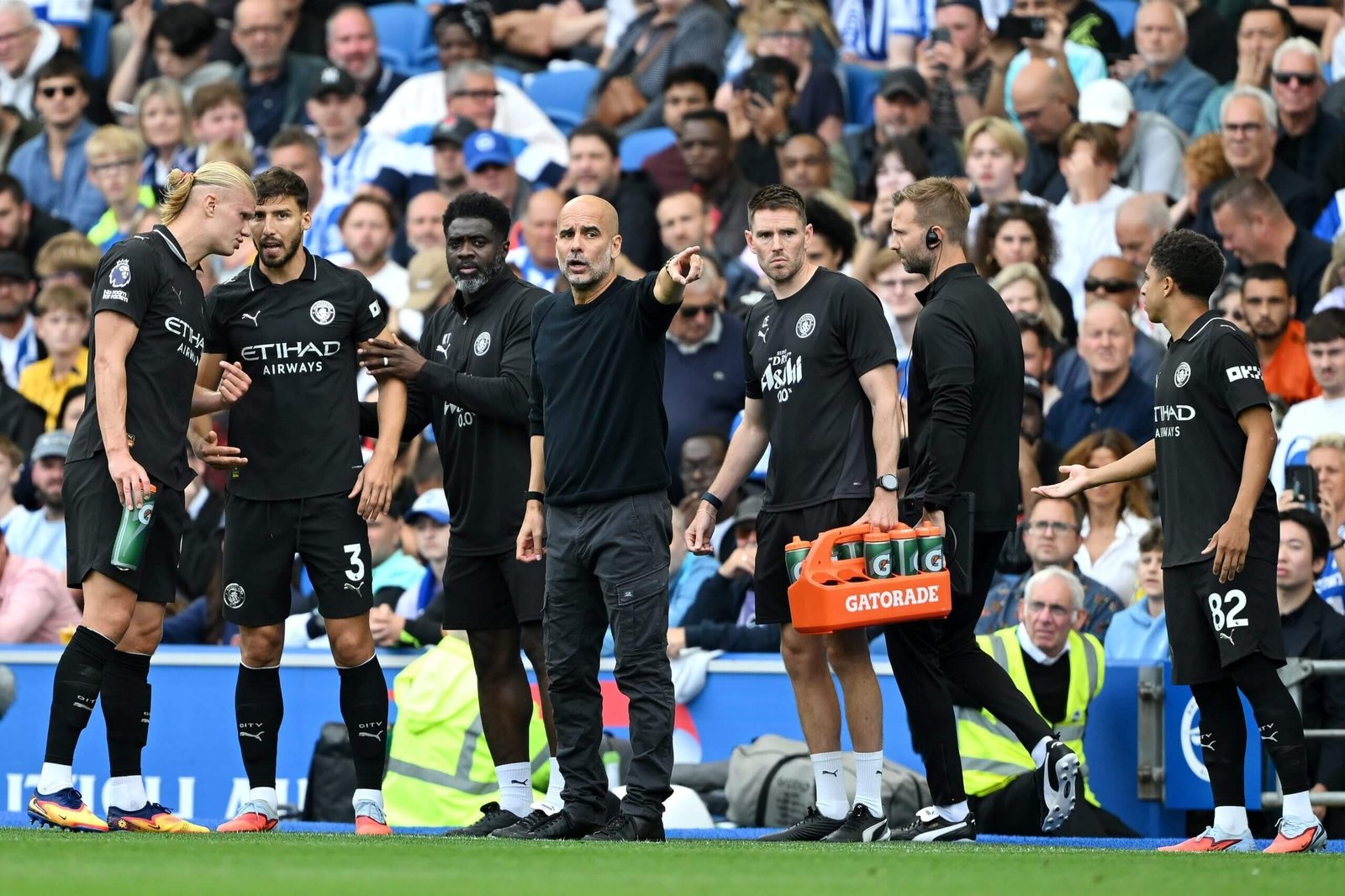
Guardiola instructing his players (Mike Hewitt/Getty Images)
It would have been unthinkable a year ago, but this is what happens when a team loses its aura. Brighton attacked with abandon and City could not muster any form of resistance as they gradually ceded more and more ground to the home side.
City may well have believed that a summer break would cure their ails and time would simply consign last season’s mid-season collapse to Room 101, but the rest of the league does not forget. What City internalise as an anomaly, the Premier League’s ferocious middle class views as wounds waiting to be reopened.
A champion boxer being put on his backside for the first time alters perception and removes a layer of the mystique. A granite chin is a mirage that cannot be rekindled once vulnerability has been witnessed. It humanises them, reframes their flaws from abstract to actionable.
The same applies to City. Once a team like them collapses as dramatically as they did for as long as they did, they cross the rubicon.
Managers are no longer as cautious, players are no longer as submissive, supporters are no longer as in awe. When City go 1-0 up in the first half, teams are no longer bunkering down to limit damage; they are punching their way out of the corner.
Despite the two losses, City do not need to enter crisis mode again. They are nowhere near the bleak period they endured between October and February last season but they do not currently look capable of the consistency required to win the title.
Khusanov performed well alongside Stones and has the pace to carry out the aggressive high line, Tijjani Reijnders is of high calibre and Oscar Bobb looks ready to make the right wing his own.
The issue is that there are too many positions that remain undecided and too many questions hanging over individuals. Goalkeeper, right-back, centre-back, the right of midfield and left-wing are all in a seemingly permanent state of flux and the wide areas are still being targeted.
City have a stockpile of very good, if not great, players but they are lacking chemistry. The defensive line is far too often out of alignment, the midfield is still searching for balance between security and verve, while the front three are lucky to combine more than a handful of times per game.
There is much to ponder for Guardiola but his team look like they are experiencing the growing pains that come with being in transition and coming to terms with no longer possessing a fear factor.
(Top photo: Justin Setterfield/Getty Images)