
I came, I saw, and I built a thriving island-empire in Anno 117: Pax Romana’s version of Ancient Rome, though I’m not sure I agree on that “Pax Romana” part. This game is anything but peaceful. Unyielding Celts and treacherous Romans aren’t the only reasons why Ubisoft’s city-building game scores many points in the “liveliness” department; between loud taverns, busy workplaces, needy citizens, riots, and the occasional great fire, Anno 117’s island-cities are hustlin’ and bustlin’ harder than a real-world town.
As someone who’s played many city-building games but hardly any Anno, building my empire whilst being entertained by the campaign’s story was an unexpected delight. Although I initially expected a lengthy tutorial rather than a full-blown narrative, the campaign turned out to be far deeper than that, and I’ve become quite entranced by its intriguing characters and unexpected plot twists.
That’s not to say that Anno 117 comes without a steep learning curve; I struggled to find my way around the production lines (you must select the end product to see the required resources), I needed more than a minute to understand the governance stats, and it took me longer than I’d like to admit to take processing times into account, but once I got the hang of it, Anno 117 made a 180 turn and actually became incredibly easy to understand.

You see, Anno 117 doesn’t make anything more complex than it needs to be. Want to start your empire? You’ll find all houses, workplaces, and citizens’ needs in the same construction menu. Need new technologies? Just select them from a single, massive research tree. Wondering if your city lacks something? Open the production stats and you’ll know in an instant. Rather than “easy to learn, hard to master,” this game is “easy to use, hard to master,” and that’s something few city-building games have managed to do quite as well.
On top of straightforward menus, Anno 117: Pax Romana has three quality-of-life features that positively affected my experience in such a major way that I’m willing to fall on my knees and thank the Roman gods for them: The “relocate” tool, the “copy” tool, and shared warehouse inventories. Free building relocation allowed me to redesign my cities without major hurdles, making the planning stage slightly less important while also giving me room to experiment without having to pause the game every other minute. Saving precious time and encouraging me to design perfect districts, the copying tool then allowed me to recreate entire city quarters onto empty land.
Without the shared warehouse inventory, however, I would’ve been forced to place every part of a single production chain within the same area — think of reed gatherers near shoe weavers. Anno 117’s developers made a wise decision when they sacrificed a bit of realism in exchange for fairly liberal production placement, and by extension, the freedom to design cities the way you see fit rather than forcing a focus on infrastructure.

That’s not to say that building placement doesn’t matter in Anno 117: Pax Romana; on the contrary, it’s very important to mind area effects, such as the lovely smell of lavender fields (+1 happiness), the stinky smell of garum (-2 happiness), and the health benefits of soap (+1 health). Add the “specialists” to that list, whom you may “equip” on official buildings to provide custom area effects, and you’ve got enough buffs and debuffs in Anno 117 to optimize your islands to your heart’s content.
I found a sense of realism not only in the area effects themselves (not a single real-life Roman wanted to be neighbors with a garum producer — it really was that smelly) but the way the effects spread; if the effect concerns the product’s smell, for example, the area of effect will form a circle around the source, but if it’s a service, the range is calculated by road distance (and sometimes a combination of the two). So, everyone within travel distance of a sanctuary shall be happy, but everyone close enough to smell garum won’t be thrilled, even in the absence of a road connection.
The only time my admiration for Anno 117’s “easy to use, hard to master” formula wavered a bit was when I discovered the simplicity of the diplomacy and religion features. Diplomacy, outside the campaign, offers the usual options: Proposing alliances, signing trade treaties, and declaring war — nothing new under the Roman sun. Although it’s difficult to avoid hostilities if another leader has it in for you, computer-controlled rival leaders are fairly predictable; based on your might and reputation, plus your governance type (Celts are more prone to liking their Celtic-leaning peers), you usually know whether they’ll accept your proposals.

Early in the game, I picked a Roman God to worship based on their buffs (they can boost farming, ship-building, et cetera), forgot about it, and came back hours later to discover that my citizens had kindly converted themselves, thereby unlocking some handy passive bonuses. As far as I can tell, there’s not much more to it than that — though the frequent religious festivals are lovely to look at. That said, I don’t really mind these limitations as I’d much rather customize my islands and wage war than work my way through complex menus.
Something that bothers me more than the basic religion menu is Anno 117’s basic UI design, which, devoid of Roman- and Celtic-themed decorations, looks very bland (especially that sidebar on the left). I already voiced this dislike in my Anno 117 preview, and although I’ve gotten more used to the white-on-blue icons and the dull grey mini-map by now, like them, I cannot.

Luckily, the rest of the game is gorgeous, especially the Roman “Latium” region with its bright colors, stately columns, and lush gardens. Although Anno 117 is certainly not intended to be “historically accurate” — Rome was built on seven hills, not seven tiny islands — I appreciate the many historical details: white carrots (instead of orange), mosaic floors, typical Roman watchtowers, Plebeians wearing more elaborate clothing than the Liberti, and so much more. If only the developers had included the eight-piece “panis quadratus” bread instead of a four-piece variant… But no game is perfect, is it?
Even if there wasn’t any city-building gameplay, I feel I could spend a good few hours just observing Anno 117’s lively world. Zoom in on a soap maker’s workplace, for example, and you’ll see people drying the lavender, carrying resources inside, mixing the ingredients, and inspecting the fresh blocks of soap. There are limits to what an Anno 117 NPC can do; for example, you’ll see someone hovering over the soap, but not actually cutting the pieces, which would require a far more detailed animation. Likewise, farmers will do their job, but always near the farmhouse, never in the field. These are details I’m not sure our rigs could handle anyway, so I don’t really mind their absence.
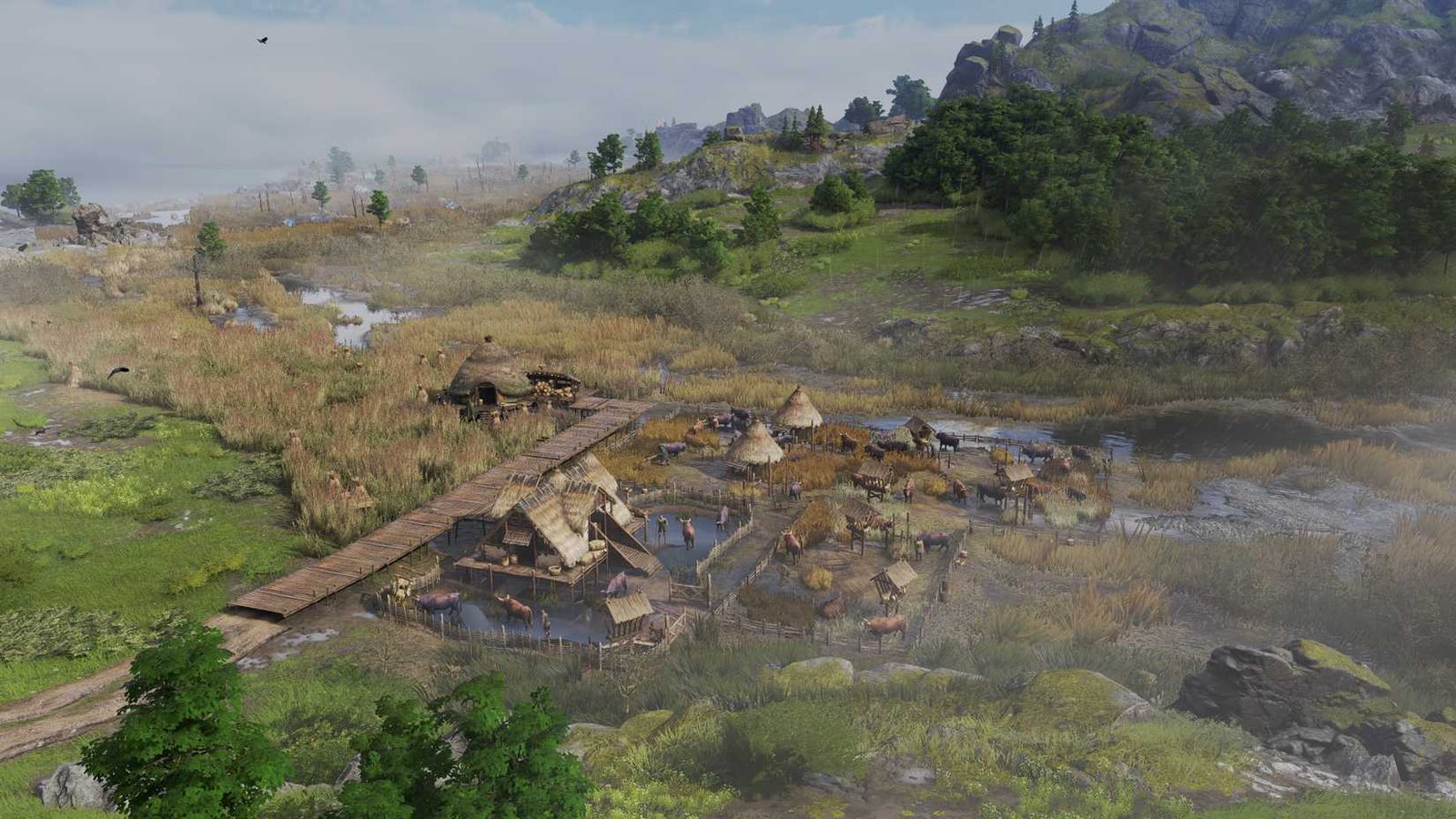
If you zoom out, however, realism makes way for a fairly strict grid layout with horizontal, vertical, and diagonal road placement. The latter is a new feature in the Anno series. Although this does create more dynamic, bendy pathways, don’t expect complete freedom. Since the building blocks don’t change their shape (always keeping their rectangular form), I found it very hard to design natural, round-ish districts. This doesn’t matter as much when you’re building Roman cities on the default “Latium” map, as the Romans used strict grid layouts in real life, but the design limits are felt quite strongly in Celtic towns, which become available on Anno 117’s second map: The green, swampy region of Albion.

In the example above, you can see that the curvy path still has its sharp corners; rather than bending gradually, each straight line is visible when zoomed in. Try adding some houses to that road, and it’s almost impossible to unsee the straight lines and square blocks that form your town.
On top of that, whereas Roman houses on the Latium map come with seven different appearances to mix and match, Albion’s Celtic houses only get four. Each design variation consists of a big rectangular house with one of two smaller shacks at its side, making them look very similar from a distance, and furthering that “grid-like” appearance. Putting them side-by-side, the Latium region looks far more authentic than Albion.

But Latium’s superiority doesn’t extend into the gameplay; thanks to Albion’s tension between the Celtic locals and the Roman invaders, its politics are more intriguing. Romanizing the Celts without pissing them off is a difficult balancing act, but when I decided to side with the local Celts in a second playthrough, the Romans did not like that.
When Rome is unhappy, war isn’t far off (so much for “pax”), so I raised barracks, built ships, and erected a big wall around my town to keep the enemy out. With various troops to unlock and choose from, such as legionaries, cavalry, and “scorpione” crossbow-operators, Anno 117 offers plenty of opportunities to experiment with warfare tactics, even though the main commands (select troops, move, stand defensively, attack) are as easy to use as the construction features. Send your horsemen to flank the opponent, for example, or use foot soldiers to lure them onto a narrow bridge and have the archers deal with them (great tactic, 10/10 would recommend).
Taking a few pointers from history, I tried to mimic Julius Caesar during the Battle of Alesia and erect a double wall, and although I ran out of wood, it’s good to know that you can do this sort of stuff. The only thing I found lacking in land warfare was the Roman troop formations, which I couldn’t manually alter as much as I would’ve liked — though this might’ve made them both harder to manage and too superior to the lesser-organized bands of Celtic axe-bearers.

Not unimportant in a game made up of small islands reachable by ship, naval warfare is equally thrilling. Although the main features were as I expected, including bulk-selecting ships, laying siege, and retreating to the safety of your own coastal defense towers, the shipbuilding mechanics contain various customizations, allowing you to adjust speed, HP, and attack type. Once you’ve shaped your perfect vessel in Anno 117, don’t forget to zoom in — you can actually see the tiny soldiers stationed on a military ship.
Though part of me wishes to blend Latium’s looks with Albion’s cultural variety, Anno 117: Pax Romana makes one spectacular city-building game. Without menu clutter, Ubisoft’s latest is relaxing and strategically challenging at the same time, and I could easily see myself returning to Anno 117 in the future without much hassle — if the initial fixation wears off, that is.
Anno 117: Pax Romana will be released Nov. 13 on PlayStation Windows PC, and Xbox Series X. The game was reviewed on Windows PC using a prerelease download code provided by Ubisoft. You can find additional information about Polygon’s ethics policy here.